

A familiar moment on the street
You’re walking through a place like Shibuya Crossing in Tokyo, or down a busy sidewalk in New York, and you get that sharp feeling that someone is looking at you. You turn your head and a stranger’s eyes are already on you, or they snap away a split second too late. It can feel oddly personal, even when nothing is happening. There isn’t one single “watched” situation behind it. It’s a bundle of fast perception, social expectation, and a brain that treats eye contact as high-priority information.
The core mechanism is simple: human attention is tuned to faces and gaze direction. That tuning runs early and fast. It doesn’t always wait for full certainty. So the feeling can arrive before you’ve consciously identified who is looking, or even whether they really are.
Your visual system is built to notice eyes
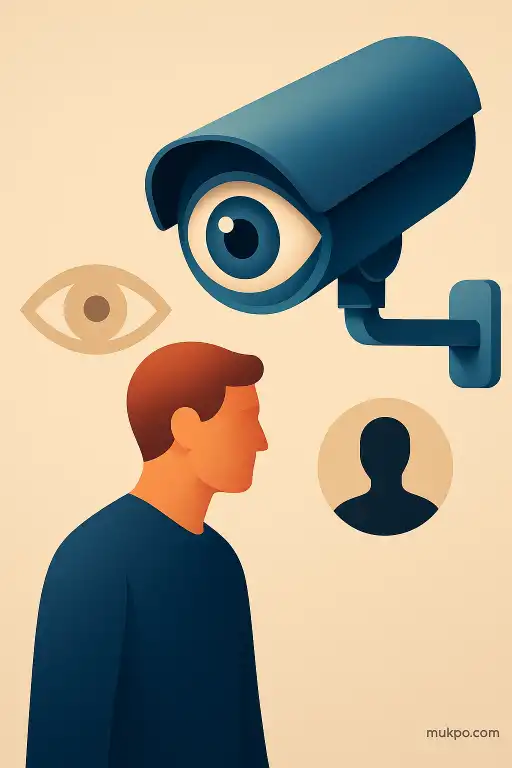
People are unusually good at picking up gaze cues compared to most other visual details. Eye whites (the sclera) make it easier to judge where someone is looking, even in peripheral vision and even when the face is small. That matters in crowds, where you rarely get a clean, centered view. A slight head angle, a hint of pupil position, or even the symmetry of a face can trigger “they’re looking at me” as a quick working guess.
One overlooked detail is blink timing. When someone stops to look, their blinking often changes for a moment. If your eyes catch a face that’s unusually still, it can stand out as “attention.” It doesn’t mean the person intended anything. It’s just a tiny movement pattern your brain uses as a signal.
Peripheral vision fills in blanks fast
Most of the time, you detect a look before you look back. That detection often happens off-center, where vision is blurrier and more sensitive to motion and contrast than to fine detail. A face turning in your direction is a strong motion cue, so your brain tags it quickly. Then it predicts the most relevant interpretation: direct attention toward you.
This is also why it can happen when nobody is actually staring. A person can glance past you at a sign, a subway map, or a friend behind you. From the side of your eye, the difference between “at you” and “through you” is hard to resolve. The feeling can be the brain’s placeholder while it waits for confirmation.
Social rules make eye contact feel loaded
Eye contact carries social meaning, even when you don’t want it to. In many cultures, a brief look is normal and extended eye contact is treated as a signal: interest, challenge, judgment, or concern. The exact norms vary between places and situations, and it isn’t always clear where the line is. But your brain still has to pick an interpretation quickly, because the cost of missing a real social signal can be high.
A concrete example: on a quiet train platform, a stranger looking up as you approach can feel intense. There’s less visual noise. There are fewer competing explanations. In a packed café, the same length glance might barely register because your attention is split across many faces and movements.
Memory and mood change the “being watched” threshold
The sense of being watched isn’t just about what’s out there. It’s also about your internal threshold for calling something a “look.” Stress, self-consciousness, lack of sleep, or recent awkward interactions can lower that threshold. Then a neutral glance lands with extra weight. You notice it sooner, and you remember it longer than the dozens of non-events around it.
Attention also edits the replay. If you turn and catch someone’s eyes, your brain tends to stitch the moment into a story of continuity: they were watching, you detected it, you confirmed it. What’s usually missing is the timing. In many cases, the stranger looked up because you turned first, or because something else in the scene changed, and both of you simply met at the same instant.

Related reads
- Why Saturn’s rings vanish and reappear depending on our viewpoint
- When an entire harbor froze solid and the climate mechanics that caused it
- Why the walking palm appears to relocate and the root mechanics behind it
- The bakery oven that chimes at midnight with an impossible melody
- When uncontrollable laughter spread through Tanganyika schools in 1962
- How a Second Empire impresario tried to replace Parisian musicians with clockwork automatons