
A road closure for an animal that isn’t big
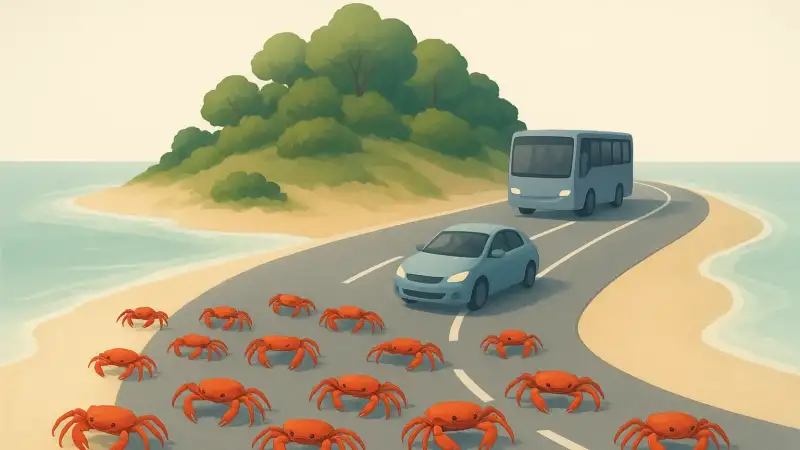
On Christmas Island, an Australian territory in the Indian Ocean, there’s a time of year when cars simply stop being the priority. Temporary barriers go up. Rangers and volunteers stand around with clipboards. Some roads are closed outright. Others turn into slow, careful corridors. The reason isn’t a storm or a parade. It’s red crabs moving from the forest toward the sea to spawn. The mechanism is blunt and practical: if you keep normal traffic flowing, the crabs die in huge numbers, and the migration breaks down fast.
This isn’t one single “crab island” story, though Christmas Island is the famous one. Similar traffic disruptions happen in places like Taiwan’s Lanyu (Orchid Island) during peak movements of land crabs, and on parts of the Caribbean where mass crab crossings meet coastal roads. The exact rules and timing vary, and they can shift year to year depending on rain and tides.
How the migration picks the day
People often assume the crabs follow a fixed calendar. They don’t. On Christmas Island, the red crab migration is tied to the start of the wet season. Rain softens the forest floor and reduces dehydration risk, so crabs can move longer distances in daylight. The big push also needs the ocean to cooperate. Spawning is timed so larvae have a better chance of being carried away by currents rather than stranded near shore.
That timing creates the traffic problem. You can have a road that’s normal on Monday and basically unusable on Wednesday. If the first heavy rain comes late, the peak shifts. If it comes in bursts, you can get waves of movement instead of one continuous flow. That uncertainty is why closures tend to be flexible and why local announcements matter more than a date printed on a tourist brochure.
What “stops traffic” actually looks like
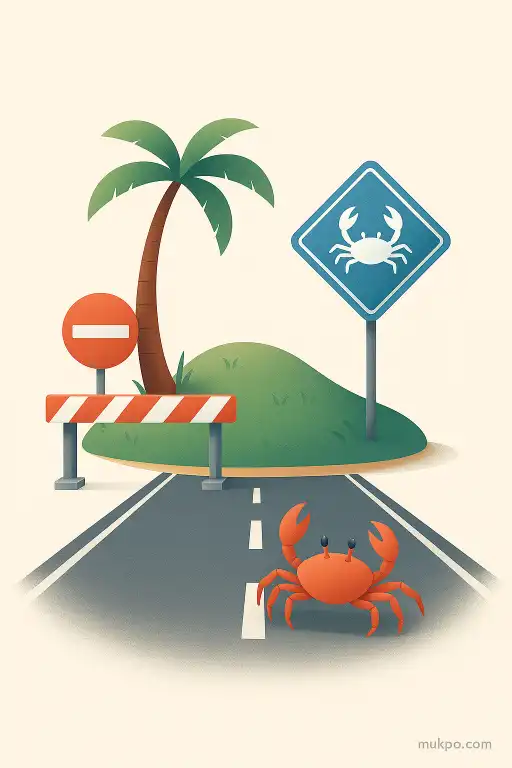
It’s not always a dramatic, island-wide shutdown. On Christmas Island, some roads close and others stay open with speed restrictions, spotters, and detours. In key crossing areas, plastic “crab fences” guide animals toward underpasses or culverts. These are not decorative. They’re installed to prevent crabs from spreading across a wide stretch of asphalt where cars can’t avoid them.
A detail people overlook is that the danger isn’t only the tires. The road surface itself is a trap. Hot asphalt dries crabs out. Steep curbs turn into walls for small bodies. And once a few are crushed, the slick remains can make the surface worse for the next wave. That’s why management focuses on channeling the flow into narrow, protected routes instead of trying to “share the road” across an entire width.
The work behind the scenes
On Christmas Island the effort is coordinated by Parks Australia (Christmas Island National Park), and it’s logistics-heavy. Barriers have to go up before the leading edge arrives. Crews need to guess where the densest streams will appear, because the crabs don’t all emerge from the same places each year. Some stretches are easy to fence. Others have driveways, drains, and intersections that need custom fixes.
Underpasses sound like a simple solution, but they only work if the entrances line up with crab behavior. Crabs tend to follow edges. They cluster along walls and fences. If the opening is a few meters off the main line, many won’t find it. So you’ll see people constantly adjusting the guidance fencing, plugging gaps, and clearing debris that changes the “edge” the crabs are following.
Why the island bothers to do it
For Christmas Island, this isn’t just about being nice to wildlife. Red crabs are a keystone species there. Their feeding and burrowing change what seedlings survive, how leaf litter breaks down, and how nutrients move through the forest. When a big migration is disrupted, the effects don’t stay on the road. They ripple into the island’s ecology in ways that are noticeable over time.
There’s also a human reason that’s less sentimental and more immediate: a mass crossing creates real hazards. Drivers can lose traction on crushed crabs. Visibility drops when people stop suddenly to avoid them. And when crabs pile up at barriers that aren’t set right, the backup can spill into places that were supposed to stay open. So the “traffic stop” is partly conservation and partly basic risk management, happening in real time as the crabs keep moving.
Related reads
- How hydrothermal vents build lush communities without sunlight
- How we make snap moral judgments in a blink
- When the Great Stink halted Victorian Parliament
- The silent chemistry that paints autumn leaves in reds and golds
- What makes lightning behave differently over oceans and mountains
- The desert dunes that sing when you walk on them