
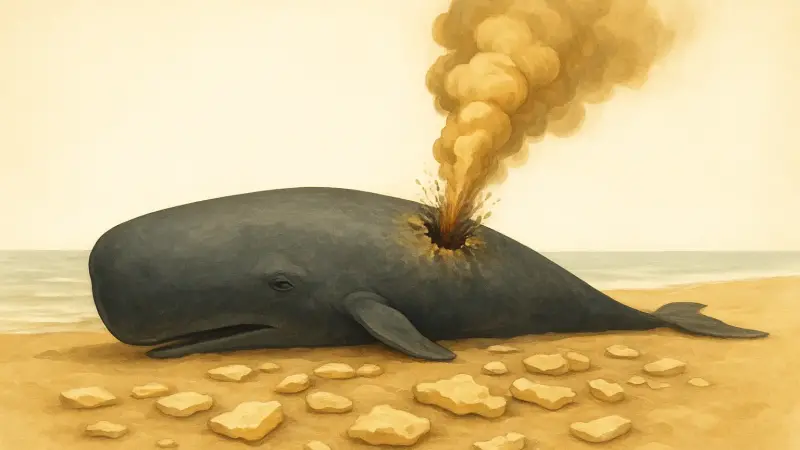
When something huge washes up on a beach, people assume the hard part is over. The animal is dead. The ocean carried it in. So why not just “get rid of it” and move on? In November 1970, that question landed on a stretch of sand near Florence, Oregon, where a sperm whale had beached and died. Local officials decided the fastest mechanism was explosives: break the carcass into smaller pieces so scavengers and the tide could finish the job. The charge went off. The whale didn’t neatly fragment. It erupted into the air, and heavy blubber rained down across the beach.
Why explosives seemed like the simple option
A whale carcass is not just “big.” It is awkward, waterlogged mass with tough skin, dense muscle, and a thick layer of fat that behaves differently than people expect. Cutting it up by hand is slow. Heavy equipment can sink in sand or get stuck. Burning is messy and can be restricted. Hauling it away means finding a place willing to accept tons of decaying animal, plus the logistics of moving it without spilling fluids.
So the idea of using dynamite can sound practical on paper. If the whale becomes chunks, the pieces are easier to bury or can be carried off by the surf. That reasoning treats the carcass like a boulder. A whale is more like a sealed, pressurized bag of oil and gas wrapped in connective tissue. That overlooked detail is where the plan starts to go sideways.
What a dead whale is doing under the skin
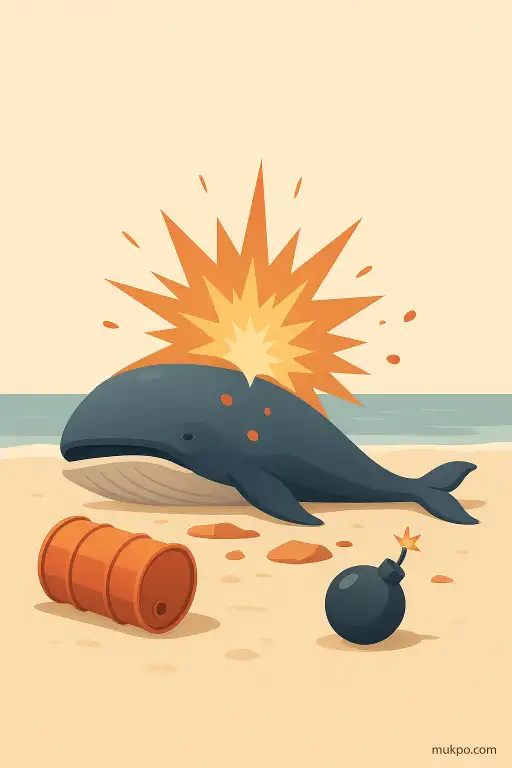
Inside a large carcass, bacteria keep working. Decomposition generates gases that inflate body cavities. At the same time, blubber is oily and elastic. It doesn’t crumble the way dry material does. When pressure builds, the body can bulge, shift, and become unpredictable. Even without explosives, this is why people sometimes hear about whales bloating and rupturing on their own.
Add an explosive shock wave and the results depend on placement, amount, and how the internal gas pockets are distributed. Those pockets are not neatly mapped. They vary by animal and by how long it has been dead. A blast can tear open one area while launching another like a wet, heavy projectile. It’s also why “more dynamite” does not reliably mean “more controlled.”
The 1970 blast near Florence, Oregon
The Florence incident became famous because it was filmed and later rebroadcast widely. The camera captures a crowd watching from what looks like a safe distance, then suddenly reacting as chunks arc outward. Blubber and meat didn’t just fall near the detonation point. Some pieces traveled far enough to hit parked cars. That part tends to get mentioned as a punchline, but it also shows a basic misunderstanding: people expected gravity to “keep the mess close.”
Another easily missed detail is the scale of what was left behind. Even after the blast, there were still large sections of whale on the beach. Explosives did not erase the problem. They rearranged it, plus they added a new hazard: airborne debris and a wider contamination area. The film also shows gulls circling, which is a reminder that scavengers arrive quickly, and they don’t care whether the carcass is in one piece or many.
What “worked” and what didn’t
If the goal was to reduce a single enormous object into smaller objects, the blast did that. But it did it in the least useful way. Pieces that land far away have to be dealt with individually. Pieces that land in soft sand can partly bury themselves, which makes later removal harder. And oily tissue can spread into the sand, which changes the cleanup from “move a carcass” to “manage a greasy beach.”
The other problem is predictability. A controlled demolition depends on knowing how material will fail. A decomposing whale is structurally inconsistent. Fat, muscle, skin, and internal cavities don’t respond uniformly. Even if the charge size is known, the carcass isn’t. That mismatch is why an operation meant to be quick can turn into a spectacle with unintended damage.
How whale disposal changed afterward
Modern responses vary by location and species, and they depend on tides, public access, and local rules. But the common direction has been toward methods that keep the hazard area smaller and the outcome more predictable. That can mean towing a carcass offshore when conditions allow, burying it deep enough that scavengers won’t quickly reopen it, or using heavy equipment to cut and remove it in a controlled way.
There’s also more attention now to what’s happening underfoot. Sand isn’t a solid platform. It shifts under machines and under people. In Florence in 1970, the beach itself was part of the miscalculation. The public could stand “far away” and still be in the impact zone, because the real boundary wasn’t distance. It was the physics of a blast interacting with pressurized, oily tissue.
Related reads
- Why people scramble to break awkward silence
- How a meteorite can seed new minerals in desert soils
- An island where cats outnumber people by the dozens
- The Italian town that banned high heels to stop tourists chipping its ancient stones
- How short routines calm decision anxiety
- The 1814 London brewery disaster that flooded streets with porter