
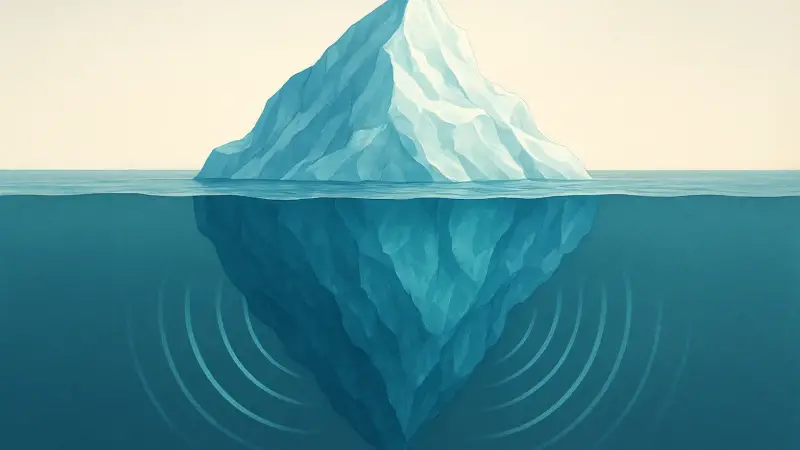
Hearing an iceberg when you can’t see it
People who work on the water around Antarctica, Greenland, and Alaska sometimes hear it first: a thin whistle, a low groan, a burst of clicks under the hull. It’s not one famous place or single event. It happens wherever icebergs drift into seawater. The core mechanism is surprisingly small-scale. Air that was trapped inside glacier ice gets released as the iceberg melts and cracks. Those bubbles don’t just rise quietly. They expand, collapse, and resonate, and that motion pushes pressure waves into the water as sound.
Where the air comes from in the first place

Glacier ice isn’t a solid, glassy block. It starts as snow. As layers build up, the weight squeezes the snow into firn and then into ice, sealing tiny pockets of ancient atmosphere inside. Some bubbles stay small and isolated. Others link up along grain boundaries. How much air is trapped, and how it’s arranged, varies with the glacier’s history, temperature, and how fast it compacted, so the sound can vary a lot from one iceberg to the next.
A detail people often overlook is that the air is under pressure inside the ice. It was sealed in when the ice was buried under many meters of overlying snow and firn. When that bubble finally connects to seawater through a crack or a melting channel, the pressure difference matters. The release isn’t just “a bubble floating up.” It can be a quick, forceful expansion that makes a sharper acoustic pulse.
How melting turns bubbles into sound
Underwater sound needs a push-and-pull change in pressure. A bubble is good at that. When a bubble is suddenly formed or suddenly freed, it doesn’t settle instantly. It oscillates. Water rushes in and out as the bubble compresses and expands until it damps out. That oscillation has a natural frequency that depends mostly on bubble size and the surrounding pressure. Bigger bubbles tend to “ring” lower. Smaller ones ring higher, sometimes into the ultrasonic range.
Melting also creates pathways that shape the noise. An iceberg can develop narrow channels and cracks that act like little release valves. A series of bubbles escaping through the same small opening can produce repeated clicks. If a crack widens in steps, you can get clustered pops as new bubble-rich layers are exposed. That’s why the same iceberg can sound busy one hour and quiet the next, even if it looks unchanged above the surface.
Cracks, grinding, and the deeper notes
Not all iceberg sound comes from bubbles. Some of the deeper groans are mechanical. Ice fractures propagate quickly, and the sudden slip can send low-frequency energy into the water. Pieces can also rub and grind as waves lift them. If the iceberg rolls or sheds a slab, the motion can drive long, low sounds that carry far. Which sound dominates depends on what the iceberg is doing: steady melt and bubble release versus active cracking and shifting.
Water pressure changes the “voice” too. Near the surface, bubbles expand more and can oscillate differently than they do a few tens of meters down. The seawater’s temperature and salinity also matter because they change sound speed and damping. That’s one reason recordings from polar fjords can sound different from recordings taken in the open Southern Ocean, even when both are “just icebergs.”
What listeners actually record, and why it matters
Researchers and crews use hydrophones to pick up these noises because underwater sound travels well, especially at low frequencies. A drifting iceberg can be audible from far away compared with what the eye can catch in fog, darkness, or rough seas. The exact distances are variable and depend on conditions, so it’s not a fixed “you can hear it from X miles” situation. But the principle holds: water carries pressure waves efficiently, and ice events create them.
The bubble sounds are also a clue about the ice itself. Bubble-rich, glacier-derived ice behaves differently from clearer ice formed by freezing seawater. When an iceberg is actively shedding trapped air, that’s information about melting rate, cracking, and which layers are being exposed. Sometimes the most telling part of a recording isn’t the loudest groan. It’s a fine spray of tiny, fast clicks that suggests a fresh surface is being opened up and degassing into the sea right then.

Related reads
- Why favourite songs suddenly sound different
- Shortwave number stations that still broadcast coded messages
- The 1970 Oregon operation that detonated a beached whale and scattered blubber across the beach
- Why people scramble to break awkward silence
- How a meteorite can seed new minerals in desert soils
- An island where cats outnumber people by the dozens