
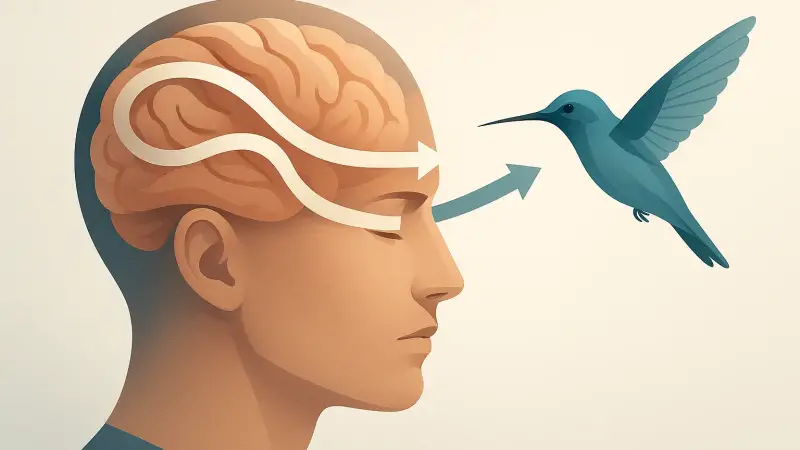
You meet someone for the first time and, within seconds, you feel like you already “get” them. There isn’t one single place or event behind that feeling. It shows up everywhere, from hiring decisions in the U.S. and the U.K. to split-second policing judgments, to how juries react to a defendant’s face on day one of a trial. The core mechanism is simple: the brain uses mental shortcuts to sort messy information fast. Those shortcuts are useful when time is tight. But they also smuggle in assumptions, old memories, and surface cues that were never meant to carry that much weight.
Fast thinking is built for speed, not accuracy
A snap judgment often starts before the person has enough information to justify it. A face, a tone of voice, a job title, an accent, a uniform. The mind grabs whatever is easiest to process and treats it like a meaningful signal. Psychologists often describe this as relying on “heuristics,” which are rules of thumb that cut down effort. They reduce the load on attention and memory. That matters because attention is limited, and real life rarely waits for careful analysis.
One overlooked detail is timing. People often think the judgment happens after they notice several features. In reality, the order can flip. A quick global impression lands first, and then the mind searches for details that fit it. That makes the later details feel like the reason, even if they arrived after the feeling.
Prototypes and stereotypes fill in missing information

When information is incomplete, the brain fills gaps with prototypes: rough internal “typical” examples of categories. That can be harmless, like expecting a firefighter to carry equipment. It can also be socially loaded, like assuming competence, threat, warmth, or honesty based on cues that are only loosely related to those traits. The shortcut is not usually experienced as “I’m stereotyping.” It feels like plain perception. The person just seems trustworthy, or seems sketchy, or seems smart.
A concrete situational example: a rushed hiring manager scans a résumé and sees one signal that matches their prototype of a strong candidate—say, a familiar company name or a prestigious university. That cue can dominate. Smaller signals that would matter in a slower review, like a pattern of short job tenures or a role mismatch, get quietly downweighted. The category match does the heavy lifting.
Availability and emotion decide what feels “common”
Another shortcut is availability: people judge how likely something is by how easily examples come to mind. That “ease” is not a clean measure of frequency. It is shaped by vividness, recent exposure, and media repetition. A dramatic incident can loom larger than a hundred ordinary ones. The mind then treats that mental ease like evidence. The judgment feels grounded, even when it is mostly grounded in what was easiest to recall.
Emotion adds fuel. If a cue triggers anxiety, disgust, or excitement, it boosts attention and memory. That makes related examples easier to retrieve later. The next time a similar cue appears, the shortcut fires faster. The person may not notice the emotional step at all, because the feeling arrives as a sense of certainty, not as a named emotion.
Context changes the shortcut you reach for
Snap judgments are not fixed traits. They shift with context. Time pressure pushes people toward simpler cues. Cognitive load does too. So does ambiguity, like when someone’s role is unclear or their behavior is hard to interpret. Even the physical environment matters. Noise, heat, or a crowded room can reduce patience for complexity, making the mind more willing to accept the first coherent story it can build.
One specific detail people tend to overlook is how much “default” assumptions do when information is missing. If someone doesn’t provide a clear explanation for why they’re late, the mind often supplies one from the nearest available category: careless, disrespectful, unreliable. If the situation later reveals a delayed train or a childcare emergency, the original snap judgment can still linger because it was formed under uncertainty, not because it was carefully supported.
First impressions stick because the mind protects its story
After a quick judgment forms, the mind tends to treat it as a working model. New information is filtered through it. If the model is “competent,” mistakes get framed as exceptions. If the model is “untrustworthy,” neutral actions get scanned for ulterior motives. Psychologists call this kind of pattern confirmation bias. It is not usually conscious. It feels like simply noticing what’s there.
There’s also a social layer. Once someone has voiced a first impression in a group, that impression can become a reference point. Others may start watching for supporting details, because shared narratives reduce friction. The original snap judgment then gains weight not because it was accurate, but because it became easy to coordinate around in conversation.
Related reads
- How mangrove roots act like natural filters for microplastics
- How Saturn’s polar winds carve a hexagon
- The deep-sea shrimp that carries bacterial gardens on its claws
- Why certain smells unlock exact moments from your past
- A postcard that arrived nearly a century after it was mailed
- How micrometeorite impacts forge glass beads in lunar soil