
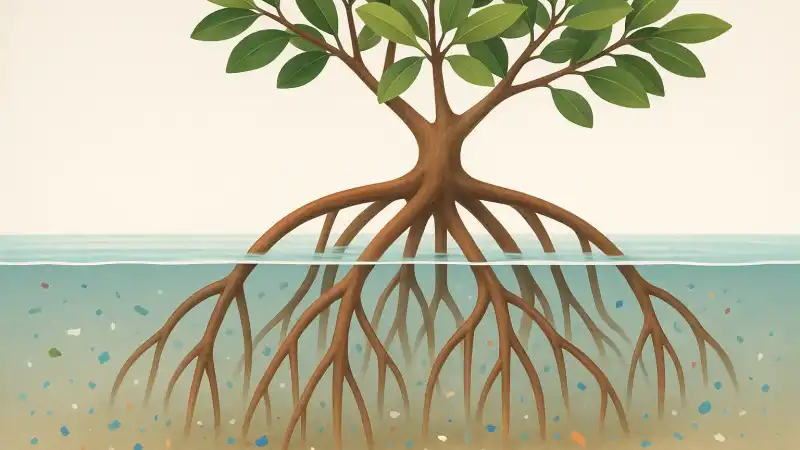
A question people rarely ask at the shoreline
People talk about mangroves as storm buffers and fish nurseries. The quieter question is what they do to the constant drift of tiny plastic bits moving with the tide. There isn’t one single place where this happens the same way, because mangrove forests differ a lot. But it’s been studied in real coastlines like Florida’s mangroves in the Everglades, the Sundarbans in India and Bangladesh, and parts of Southeast Asia such as Indonesia. The basic mechanism is simple. Mangrove roots slow water down, trap fine particles, and build mud. Microplastics ride those particles, or get snagged directly, and end up parked in the root zone instead of staying in open water.
Roots that turn moving water into slow water
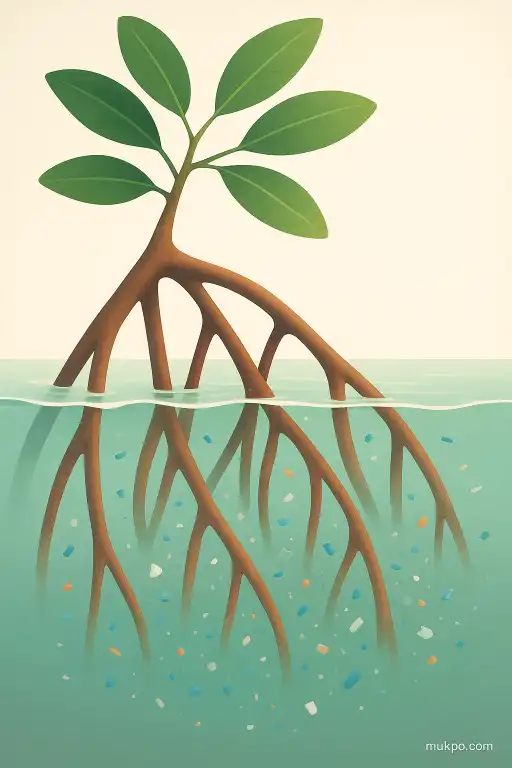
Mangroves don’t have one “root type.” Some species push up pencil-like pneumatophores, others spread prop roots like scaffolding, and many do both depending on conditions. What they share is friction. When a tide pushes through a tangle of roots, the flow breaks into small eddies and slows near the bottom. That matters because microplastics are often not floating freely. A lot of them are attached to clay, silt, or decaying organic bits, and those settle out when the water calms.
The overlooked detail is that the “filtering” isn’t a single pass like a sieve. It’s repeated. Twice a day in many places, the tide comes in and out, and each cycle drops a little more fine material into the same maze. Over weeks and months, that turns the root zone into a particle trap. The microplastics don’t disappear. They shift from being mobile to being stored, sometimes just a few centimeters below the surface where people don’t see them.
Why microplastics stick in mangrove mud
Microplastics behave differently depending on size, shape, and polymer. Fibers from clothing tend to act like lint. They snag on rough surfaces and cling to plant litter. Hard fragments are more likely to move with sand and silt. Films can drape and fold, then get pinned by debris. In mangrove water, all of these can pick up a coating of microbes and organic molecules. That coating can make them heavier or “stickier” in practice, so they settle more easily or bind to natural particles.
Salinity and suspended sediment also change the game. Where rivers meet the sea, fresh and salt water mix and cause fine particles to clump. Microplastics can get caught in those clumps the same way pollen gets caught in a wet snowball. If the mangrove stand is in a muddy estuary, the clumping and settling can be strong. If it’s on a clearer, sandier shore, a lot less gets stored in place, and more stays in motion.
A concrete scene: tides, debris lines, and the root zone
Picture a mangrove edge at low tide. There’s often a visible “debris line” in the roots where the last high tide left seaweed, twigs, and trash. That line is a hint of where microplastics go too, just at a scale you can’t easily see. Water enters on the rising tide, threads through the roots, and drops its lightest, finest load as the flow loses energy. When the tide falls, some particles get pulled back out, but a portion stays behind in the mud and in the litter caught around roots.
This is why samples taken a few steps apart can look completely different. A small channel that drains the forest can act like a conveyor belt, moving microplastics out again. A sheltered pocket behind dense roots can act like a dead-end, building up much higher concentrations. Even within one forest, the “filter” is patchy, shaped by tiny differences in root density, elevation, and how long water sits before draining.
Filtering is not removal, and it can be undone
Calling it filtration can sound like cleanup, but the more accurate idea is capture and storage. Mangrove sediments can bury microplastics and keep them out of the water column for long periods, especially where mud builds steadily. But storms, boat wakes, dredging, or a big shift in channels can resuspend that sediment. When that happens, the stored particles can move again, sometimes in a pulse that’s larger than the everyday trickle.
There’s also a biological side effect. Mangrove mud is busy with crabs, worms, snails, and microbes that churn and rework the surface. That mixing can push microplastics deeper or bring them back up, depending on the animal activity and the sediment texture. Some plastics may also fragment further under sunlight when stranded on exposed roots or litter during low tide, changing the size profile of what the next tide moves through the forest.
Related reads
- How Saturn’s polar winds carve a hexagon
- The deep-sea shrimp that carries bacterial gardens on its claws
- Why certain smells unlock exact moments from your past
- A postcard that arrived nearly a century after it was mailed
- How micrometeorite impacts forge glass beads in lunar soil
- Why you freeze during public speaking