

A familiar feeling, with no single place behind it
People often say their childhood summers felt endless, but the years after 30 seem to blur. There isn’t one town, one event, or one law that explains it. It shows up everywhere, whether someone is comparing 2019 to 2024 in the United States, noticing how quickly a decade passed in the UK, or hearing the same complaint from friends in Japan. The core mechanism is a perception trick: the brain doesn’t “play back” time like a clock. It estimates duration from memory signals, and those signals change when life becomes more routine.
Why routines make time feel smaller
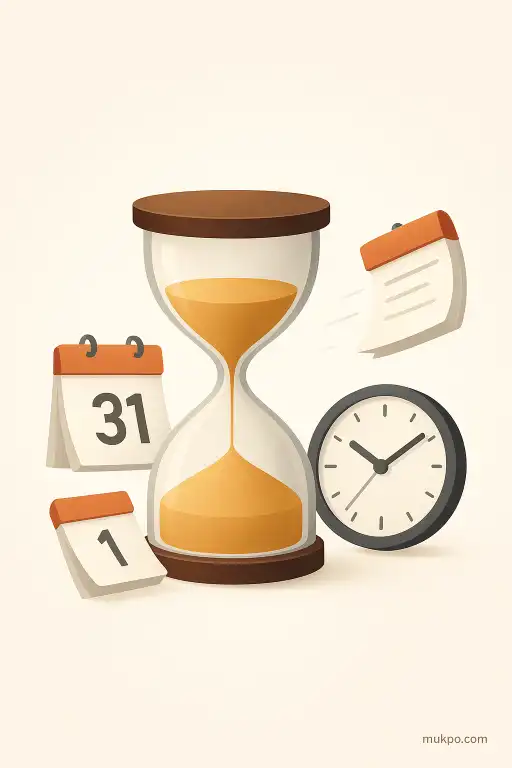
One big shift is repetition. When days follow similar scripts, the brain stores fewer distinctive markers. A commute that barely changes, the same meeting formats, the same rooms, the same screens. In the moment it can feel busy and full, but later there are fewer unique “anchors” to stretch the memory out. Looking back, a month that was mostly repeats compresses into a thin strip.
A detail people usually overlook is how much “first time” content props up duration. The first time navigating a new airport, learning a new job system, or figuring out a new neighborhood creates dense encoding. Familiar tasks get processed with less attention and less new learning. Less new learning means fewer retrievable snapshots. The calendar doesn’t change, but the memory record does.
Prospective time vs. retrospective time
Time has two different feels. There’s the “right now” feel while something is happening, and the “looking back” feel after it’s over. Psychologists often separate these as prospective versus retrospective judgments. A long meeting can feel slow while it’s happening, then shrink to “that meeting” later. A vacation day can feel short while you’re rushing around, then expand later because it contained so many distinct scenes.
This split explains a common contradiction: a week can feel endless on Tuesday and tiny on Sunday night. The live experience is heavily shaped by attention and impatience. The later estimate is shaped by how many event boundaries the brain can retrieve. When there are fewer boundaries, the brain has less to count, so the stretch feels smaller.
Event boundaries: the brain’s invisible timestamps
The brain segments life into chunks. Doors opening, a conversation shifting topics, leaving a building, arriving somewhere new, starting a new task. These are “event boundaries.” They act like informal timestamps. More boundaries usually means a longer-looking memory, because the mind can step through more segments when it reconstructs the past.
That’s why the same number of hours can later feel wildly different. Consider two Saturdays. One is spent at home doing familiar chores, with the same rooms and the same sequence. The other includes a doctor’s appointment across town, an unexpected detour, lunch in a place you don’t usually go, and a late call you didn’t plan. Even if neither day was especially “fun,” the second one has more boundaries, more context switches, and more distinct cues to retrieve.
Why the effect often gets stronger with age
As people get older, more of life becomes predictable. Not for everyone, and not always, but the probability rises: stable job routines, stable neighborhoods, stable relationships, stable media habits. That stability reduces novelty, and novelty is a big driver of dense memory. There’s also a math-like contrast effect: one year is a smaller fraction of forty years than of ten years. The fraction isn’t the whole story, but it can add to the sense that “a year” is less substantial now than it used to be.
Another overlooked contributor is how memory is tagged by emotion and uncertainty. New roles and transitions tend to carry more uncertainty, and uncertainty forces attention. Attention increases what gets stored. When life contains fewer major transitions, fewer strong “before/after” lines get drawn in memory. Looking back, it can feel like several years belong to the same chapter, so they collapse together.
Related reads
- The San Juan pig whose shooting nearly sparked a war between Britain and America in 1859
- A hoard of century old coins uncovered beneath a town square
- The Ottoman edict that closed coffeehouses and criminalized gossip
- How mental shortcuts steer snap judgments
- How mangrove roots act like natural filters for microplastics
- How Saturn’s polar winds carve a hexagon