

A pause that changes the choice
People notice it in small moments. Your finger hovers over “Buy” for half a second. You slow down before stepping off the curb. You hesitate before sending a message that could start an argument. This isn’t one single event, and it’s not tied to one place. You can see it on a crowded platform in Tokyo, at a busy crosswalk in New York, or in a clinic waiting room almost anywhere. That brief delay can quietly tilt someone toward caution or toward risk. The core mechanism is timing. A tiny interruption changes which mental system gets to speak first, even when a person feels like they’re choosing normally.
Fast evaluation versus slower control
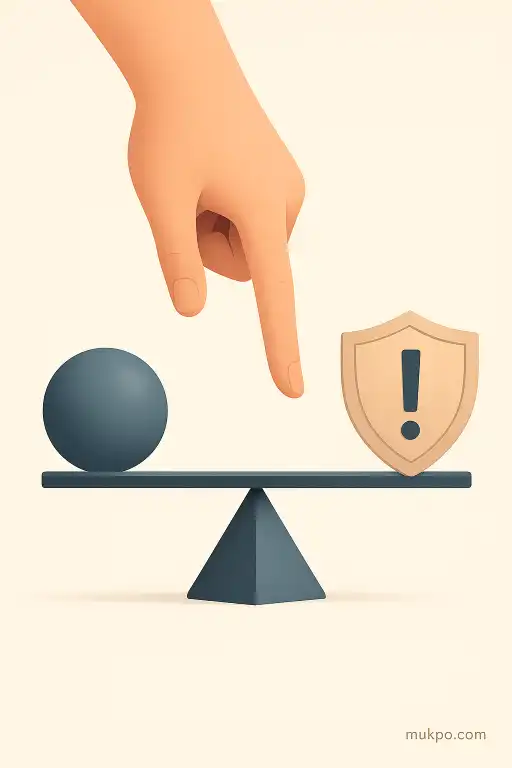
Most daily decisions start with a fast, automatic evaluation. It is quick and it is impression-based. The brain tags something as safe, dangerous, promising, or pointless before a person has a sentence for it. When there’s no delay, that first tag often carries the decision. A hesitation creates room for other signals to arrive, including rules, memories of similar situations, and social expectations.
It helps to think of it as a race between processes rather than a single “thought.” The immediate reaction is not always emotional, and the slower process is not always careful. Sometimes the slower process rationalizes a risky urge. Sometimes it applies a brake. The direction depends on what information becomes available during that brief window and which goal feels more urgent in that moment.
Hesitation can increase risk, not just caution
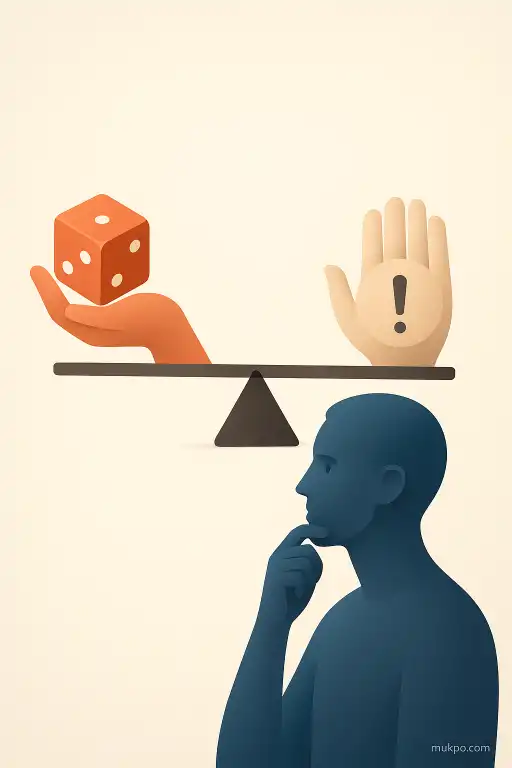
A lot of people assume a pause means self-control showed up. But hesitation can also make risk more likely. If the first reaction was mild doubt, extra time can let curiosity, reward anticipation, or social pressure build. That’s easy to see in a concrete situation like gambling. A person might start with a flicker of “maybe stop,” then hesitate, watch someone else win, and feel the pull intensify. The delay didn’t add safety. It added momentum in the other direction.
The same pattern shows up in social risk. A split-second pause before speaking can turn into overthinking and then a bolder statement, because the person rehearses it and commits. The pause becomes a tiny rehearsal space. The choice looks thoughtful from the outside, but the tilt came from what filled the gap: imagined outcomes, not new facts.
What fills the gap: attention, bodily signals, and environment
During hesitation, attention often narrows onto one detail. That detail is frequently not the most “important” one. It’s the one that’s easiest to process in the moment. In a street-crossing decision, people may over-fixate on the nearest moving car and underweight the silent one farther away. That’s a specific, overlooked detail: quieter vehicles, especially some electric cars, can reduce the usefulness of sound as a timing cue, so the pause may be filled with the wrong kind of checking.
Bodily signals also sneak in. Heartbeat, breath, and muscle tension can be read by the brain as information about threat or excitement. If the pause coincides with a surge of arousal, it can be interpreted as “this is risky” or “this is thrilling,” and those interpretations push in opposite directions. The environment matters too. A countdown timer, a notification ping, a friend watching, or a long line behind someone can all turn a hesitation into a pressure cooker instead of a safety check.
Why people don’t notice the tilt
After the decision, the mind tends to explain it as a single, coherent choice. The hesitation gets folded into the story as “I thought about it.” But the tilt can happen without any clear, reportable thought. Part of that is memory. People remember the final reasons better than the earlier, messier signals. Another part is that very short delays don’t feel like events. They feel like nothing, even though they can change which cues were sampled.
It’s also common for people to misread what caused the pause. They may think it was prudence, when it was actually a momentary search for confirmation. Or they may think it was fear, when it was just cognitive load, like trying to hold two options in mind. From the outside, the difference between “caution” and “delay” can be invisible, even when the outcome shifts because of it.
Related reads
- Victorian wallpaper woven with human hair
- A clock tower that runs counterclockwise every afternoon
- Why we reflexively glance where others are looking even in a crowd
- Why comet tails shed sodium and how sunlight sculpts them
- The Christmas truce and the impromptu football match along the 1914 Western Front
- When a 1784 Paris commission exposed Mesmer’s animal magnetism as spectacle rather than science