
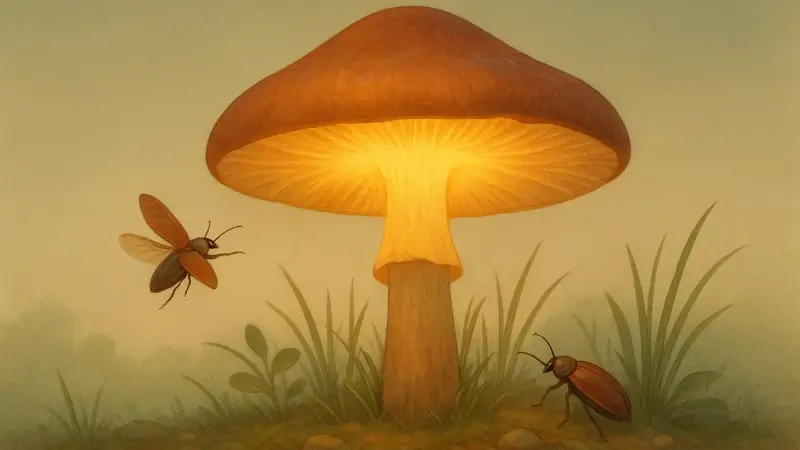
A light you can’t mistake for moonlight
In a damp forest at night, some mushrooms give off a steady greenish glow that doesn’t flicker like a firefly. This isn’t one single species in one single place. It shows up in different regions, including Brazil’s Atlantic Forest and parts of Japan, and the details vary by species. One of the best-studied examples is Neonothopanus gardneri in Brazil, which has been discussed as a case where the glow can help pull in insects. The basic mechanism is simple: the mushroom makes light through a chemical reaction in its tissues, and that light becomes a cue spring-active beetles can notice when the forest floor is otherwise dark.
How a mushroom makes its own light
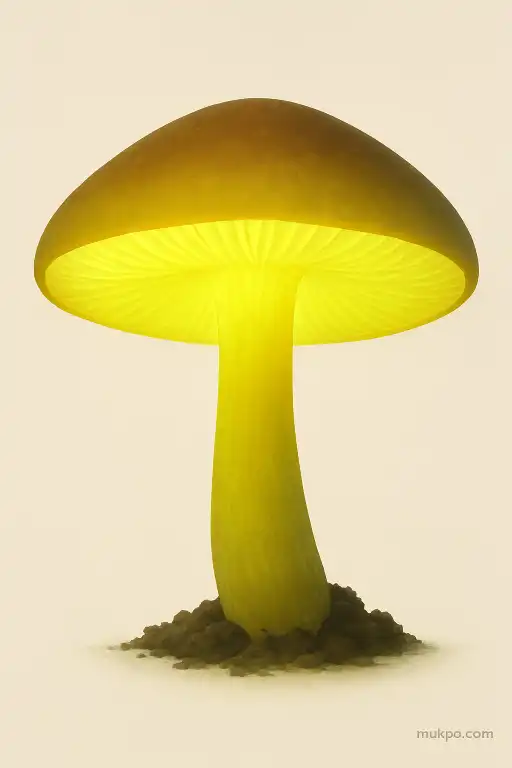
The glow is bioluminescence. It comes from a luciferin–luciferase reaction, where an enzyme helps a small molecule release energy as visible light. In fungi, the light tends to be in the green range, which travels well through leafy, low-light environments. The overlooked detail is that the glow is often strongest in specific parts of the fungus, like the gills or the edges of the cap, not evenly across the whole mushroom. That matters because those are the surfaces that shed spores or sit close to where insects land and crawl.
This light is not “heat.” It’s sometimes called “cold light” because very little energy becomes warmth. That helps in a practical way: the mushroom can glow for long stretches without cooking its own tissues. Some species also show a daily rhythm, glowing more at night and less in the day, which lines up with when many forest insects are active and when the glow is most visible.
Why beetles show up in spring
Beetles are not drawn to “mushrooms” as a category. They respond to a mix of cues. Smell is a big one, because fungi release strong volatile compounds that drift through the understory. But in spring, when temperatures rise and leaf litter moisture changes, lots of beetles start moving more, mating, and feeding. Light becomes another cue they can use at night, especially close to the ground where starlight is blocked by plants and the forest floor is full of visual clutter.
Different beetles have different reasons to approach. Some feed on fungal tissue. Some graze on microbes growing on it. Some are just using the area as a moist shelter. The common point is movement: if a glowing mushroom gets more beetles to walk over it, it gets more chances for spores to hitch a ride on legs and wing covers, or to be knocked loose into air currents by that traffic.
The attraction idea: spores, feet, and short-range travel
The “attract spring beetles” idea is usually framed as a spore dispersal strategy. Mushroom spores are tiny and abundant, but most land in useless places. If insects reliably visit a fruiting body, spores can be moved to new spots in the same habitat, especially into cracks in bark, pockets of leaf litter, or other damp micro-sites where fungal growth has a better chance. This is short-range travel, not a cross-country migration, but short-range is often enough for a fungus spreading through a forest patch.
A concrete way this can look in the field is a glowing cluster on a decaying log at night, with small beetles repeatedly walking the cap and slipping between gills. That gill contact is easy to overlook, but it’s where spores are released. Even a few seconds of contact can dust an insect’s body. Whether the insect “means to” carry spores doesn’t matter. The physics of powdery spores and frequent footfalls does the job.
What’s still unclear and why it’s hard to prove
It’s not settled that every glowing mushroom is glowing because it attracts insects. Some fungi may glow as a byproduct of chemistry that also protects against oxidative stress, or for reasons tied to metabolism we still don’t fully understand. Even when insects are attracted, it’s tricky to show that attraction leads to more successful reproduction, rather than just more visitors. Researchers have used comparisons like lit versus unlit bait, or covered versus uncovered fruiting bodies, but results can depend on species, habitat, weather, and which insects are active that week.
Another complication is that insects don’t respond to light alone. Odor, humidity, and the feel of the surface all matter. A mushroom can be bright yet ignored if it’s too dry, too old, or producing different scents than usual. So when people say a glowing mushroom “attracts spring beetles,” it’s often a description of a tendency observed in certain places and species, rather than a universal rule for all bioluminescent fungi.
Related reads
- Why bread sometimes grows mold in perfect circular patches
- An elevator that refuses to open on floors with odd birthdays
- How volcanic ash shapes global weather patterns
- How a tiny meteorite impact changes local soil chemistry
- The bench that always held a single lost glove belonging to the same person
- Why ordinary noises seem louder and creepier at night