
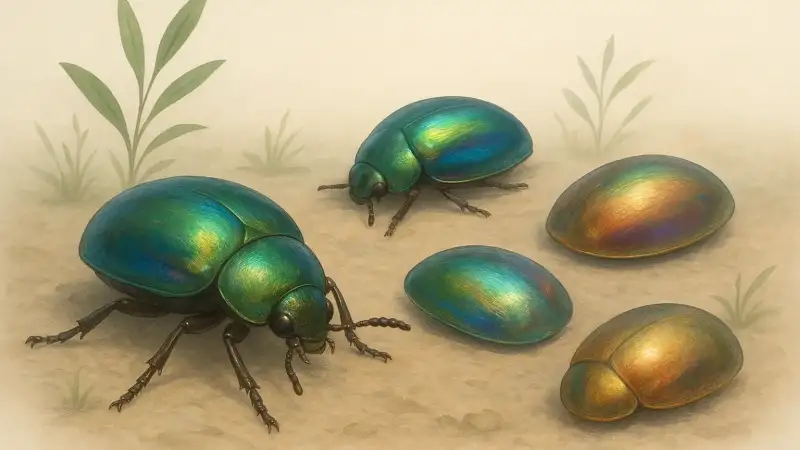
That metallic beetle look isn’t always “color”
Pick up a jewel beetle (family Buprestidae) in the right light and it can flash green, blue, even copper. That effect shows up in lots of places, not one famous event or site. You’ll see it on jewel beetles, many scarab beetles, and some tiger beetles, across regions from Southeast Asia to Australia to the Americas. The surprising part is that the shimmer can happen with little or no pigment doing the work. Instead, the shell’s surface is built like a tiny optical device. Light hits it, bounces around in thin layers, and certain wavelengths come back stronger than others. The shell is “engineering” the color by structure.
How a clear material makes a bright color
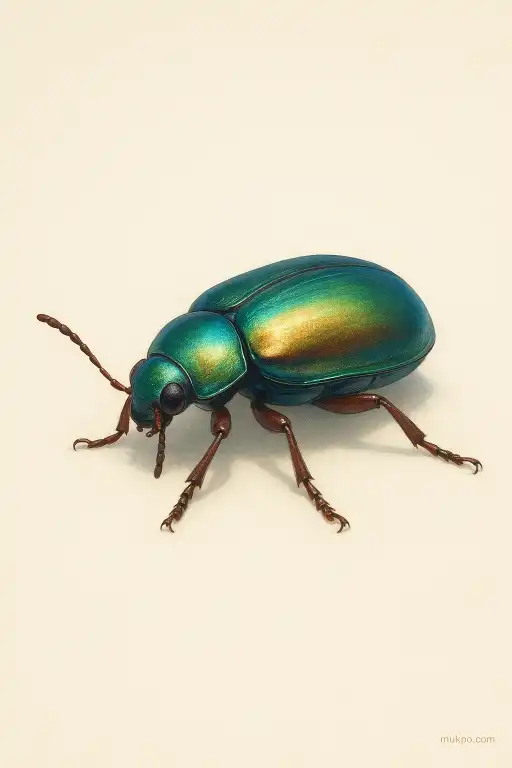
The outer shell is mostly chitin and proteins, which are not inherently shiny green or blue. The trick is that the cuticle is layered. When light reflects from the top of a layer and from a boundary deeper down, those reflections can add together for specific wavelengths. That’s thin-film interference, the same basic physics that makes an oil slick look rainbowy.
Beetles often take it further by stacking many layers with slightly different thicknesses. Some species also arrange the layers in a twisted, helical pattern, which can reflect circularly polarized light. That detail is easy to miss because human eyes don’t directly “see” polarization the way they see red versus green, but instruments can measure it, and some animals can detect it.
Why the color shifts when you tilt the shell
One giveaway that the color is structural is angle dependence. Tilt a shimmering beetle and the hue often shifts. That happens because the effective path length of light in those layers changes with viewing angle. Different wavelengths now line up to reinforce each other, so the dominant reflected color moves.
A concrete example: museum drawers of jewel beetles can look dull under flat overhead lighting, then suddenly flare when someone slides the tray and the angle changes. The shell isn’t “turning on.” The geometry is changing. The same specimen can look green from one direction and more bronze from another because the layer spacing selects different wavelengths depending on how the light arrives and leaves.
What pigment still does (and what it doesn’t)
“Without pigment” doesn’t always mean “no pigment at all.” Some beetles combine a structural reflection with dark melanin underneath. The melanin acts like a light sink. It absorbs stray light that would otherwise wash out the interference colors. People often overlook that the best iridescence can depend on having something dark behind it.
Other pigments can be present but play a smaller role than expected. A yellow or brown pigment layer can tint the structural color, shifting a pure green toward gold, for example. But the sharp, metallic gleam usually comes from the physical microstructure, not from dye-like molecules soaking up and re-emitting light.
How the shell’s microstructure survives wear and time
A pigment-based color can fade if the molecules break down, but structural color is tied to shape. As long as the layers and spacings stay intact, the optical effect can persist for a long time. That’s one reason old beetle specimens can still look vivid decades later, even though their bodies have dried out.
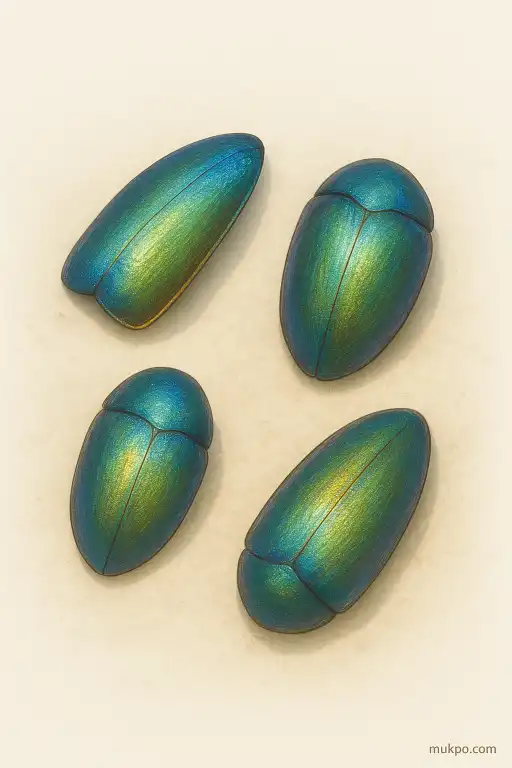
At the same time, small surface damage can matter more than people expect. A thin scratch can disrupt the layer order or roughen the surface just enough to scatter light, which softens the shimmer. Dust and oils can do something similar by filling tiny features and changing the refractive index at the surface. The color isn’t painted on, so the condition of the surface architecture is the whole game.
Related reads
- The café chair that always ends up in the sunny window
- How having too many options makes decisions feel impossible
- Why strangers’ glances sometimes feel like being watched
- Why Saturn’s rings vanish and reappear depending on our viewpoint
- When an entire harbor froze solid and the climate mechanics that caused it
- Why the walking palm appears to relocate and the root mechanics behind it