
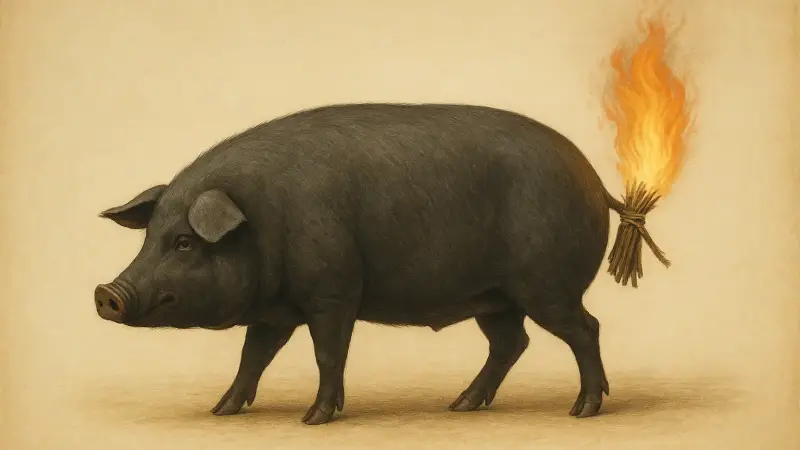
A gunshot on a quiet island
People rarely ask how a border dispute actually turns into a crisis. On San Juan Island in 1859, it started with something plain: a farmer, a pig, and a gun. The island sat in the middle of the San Juan Islands, between Vancouver Island and the Washington Territory, and both Britain and the United States claimed it. So when an American settler shot a pig that had been rooting in his garden, the argument wasn’t only about livestock. It landed straight on the question of whose law applied on that patch of ground, and who had the right to enforce it.
Why the island’s ownership was unclear
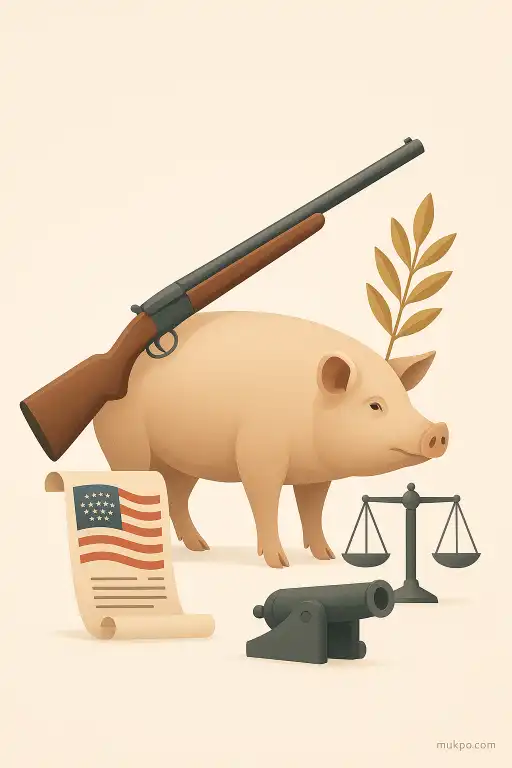
The problem came from a map line that sounded simple and wasn’t. The Oregon Treaty of 1846 set the boundary at the 49th parallel and then sent it “through the middle of the channel” to the Strait of Juan de Fuca. But there are two plausible “middle” channels in that water: Haro Strait to the west of the San Juan Islands and Rosario Strait to the east. Pick Haro, and the islands look American. Pick Rosario, and they look British. The words stayed the same, but the geography refused to cooperate.
By the late 1850s, that ambiguity had become daily friction. The Hudson’s Bay Company operated in the region, and British authorities treated the islands as part of their sphere. At the same time, American settlers were moving in and acting like the islands were already U.S. territory. There wasn’t a clean handoff, just overlapping assumptions and people trying to live normal lives inside them.
The pig and the immediate dispute
The animal belonged to an employee of the Hudson’s Bay Company. It kept getting into an American settler’s potato patch, and eventually the settler shot it. That part is easy to picture. The harder part is what came next. The pig’s owner wanted compensation, and the question of compensation immediately became a question of authority. If a British company’s pig was killed on British soil, British officials could push back hard. If it happened on American soil, the whole complaint looks different.
A detail people often overlook is how ordinary the argument was at first. It wasn’t a grand political statement. It was about crops, property, and someone feeling disrespected. But because there was no agreed court or sheriff for the island, any attempt to “handle it properly” risked looking like one side was admitting the other side governed there.
From local quarrel to soldiers facing each other
Once officials got involved, both governments had incentives to look firm. American authorities sent troops to San Juan Island. British naval forces appeared nearby, because Britain could not easily ignore a new U.S. garrison on land it claimed. The standoff that followed is often called the Pig War, even though the pig was the only casualty people reliably point to. The larger danger came from miscalculation. A nervous sentry, a poorly received order, a ship captain trying to protect his reputation, any of that could have turned posturing into shooting.
What kept it from sliding into combat was that the senior leaders on the spot had room to slow things down. Instead of rushing to force the issue, the two sides settled into an uneasy coexistence: soldiers present, flags implied, but restraint practiced. It’s the sort of non-solution that looks weak on paper and feels sensible when everyone can see the cannons.
How it finally ended years later
The dispute didn’t resolve quickly because the underlying problem wasn’t the pig. It was the channel. The island remained under a joint military occupation for years while diplomats worked and tempers cooled. Eventually, the boundary question was submitted to arbitration. In 1872, Kaiser Wilhelm I of Germany decided in favor of the United States, selecting the route through Haro Strait. San Juan Island and the rest of the archipelago became firmly American territory after that decision.
By the time the flags and troops were sorted out, the original quarrel looked almost absurdly small. But it had done its work. It forced both sides to confront the fact that unclear treaty language isn’t abstract when people are farming, trading, and building lives right on top of it.
Related reads
- A hoard of century old coins uncovered beneath a town square
- The Ottoman edict that closed coffeehouses and criminalized gossip
- How mental shortcuts steer snap judgments
- How mangrove roots act like natural filters for microplastics
- How Saturn’s polar winds carve a hexagon
- The deep-sea shrimp that carries bacterial gardens on its claws