
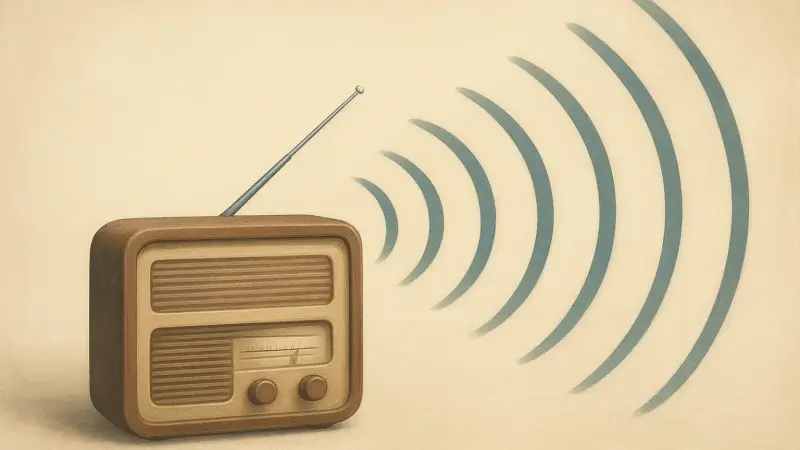
Hearing it on a quiet night
People sometimes stumble on it by accident. They turn the tuning knob late at night and, instead of talk or music, they catch a simple repeating melody that sounds like a lullaby. It isn’t one single famous frequency with one official story. Similar “shared” signals show up in different border regions, because radio doesn’t stop at customs. Around the junction of Germany, the Netherlands, and Belgium, for example, a strong FM or longwave transmitter can be heard well beyond the country that paid for it, especially after dark. The mechanism is plain: one transmitter, one carrier frequency, and a signal that rides the air far enough to spill into neighboring countries.
Why one station can cover three countries

On FM, the “three countries” effect is usually geography plus transmitter power. High antennas, flat terrain, and coastal paths can stretch coverage far past the intended area. Weather can help too. Temperature inversions can create tropospheric ducting, where VHF signals bend and travel much farther than normal. That’s why someone might hear the same gentle loop in multiple countries on the same night, then fail to find it a week later on the same frequency. It isn’t mystical. It’s the atmosphere acting like a temporary waveguide.
On lower frequencies like longwave and mediumwave, the trick is different. At night the ionosphere reflects parts of these signals back down, letting them hop hundreds of kilometers. That’s why a single longwave service can sound “everywhere” in a region after sunset, even if it’s only meant to cover one national market. A lullaby-like tune is a practical choice for a repeating loop. It stays intelligible through fading, noise, and interference, where spoken words can become mush.
What the “lullaby” usually is
Most of the time, that melody isn’t a secret broadcast. It’s a utility signal dressed in something human-friendly. Broadcasters and network operators have used interval signals, test loops, and audio identifications for decades. A simple tune can sit on a transmitter while engineers check levels, confirm that links are up, or keep a feed path “alive.” The listener hears a lullaby. The operator hears a stable reference that makes faults obvious.
One detail people overlook is that the tune may not be coming from the “station” at all. It can be injected upstream on a studio-to-transmitter link, a satellite receiver, or a backup playback device that kicks in when the main program fails. That’s why the audio can sound oddly clean and centered, even when the reception is weak. The melody is consistent. The carrier underneath it is what wobbles, fades, or gets stepped on by a nearer transmitter using the same or adjacent channel across the border.
Why it sounds the same in different places
Radio planning tries to prevent overlap, but it can’t eliminate it. Neighboring countries coordinate frequencies, yet they also reuse the same channels in different regions. A person traveling from one country into the next can hear the same audio on the same dial position for two very different reasons: the same transmitter carrying farther than expected, or two separate transmitters on the same frequency airing the same network feed. Some public broadcasters run synchronized networks, so the music and announcements match across large areas. If the network drops into a fallback loop, the fallback can match too.
Receivers also play a role. Many car radios hold onto the strongest signal they’ve locked, even as a new one rises. Some switch slowly. Some blend. In a border triangle, that can produce a strange illusion of “one frequency, one song, everywhere,” even while the actual signal source is changing under the hood. The lullaby remains steady because it’s the common content, not because the physics is unusually neat.
What makes people describe it as eerie
A repeating melody on an otherwise empty band hits a specific nerve. It’s predictable, it has no presenter, and it doesn’t explain itself. That combination feels personal, like someone left a music box running in a locked room. Radio also adds small distortions—flutter, fading, multipath echoes—that make simple tunes sound older than they are. When the signal lifts and drops with the night air, the brain reads intention into it, even though it’s just propagation.
There’s also the timing. These loops often appear during maintenance windows, outages, or low-traffic hours, which are already quiet. And because reception conditions can change minute to minute, two people in towns only a few kilometers apart can report different versions of the “same” lullaby, or one hears it while the other hears nothing. That inconsistency is usually the clue: the broadcast is real, but the reach is conditional.
Related reads
- Why certain minerals split light into rainbow halos
- A mailbox that returned postcards stamped before anyone living remembered
- Hy-Brasil the phantom island that haunted medieval maps off Ireland
- The lighthouse that slowly sank into the dunes while its light kept burning
- Victorian hairwork the 19th-century craft of weaving mourning into jewelry
- The apartment building where each elevator responds only to a specific melody