
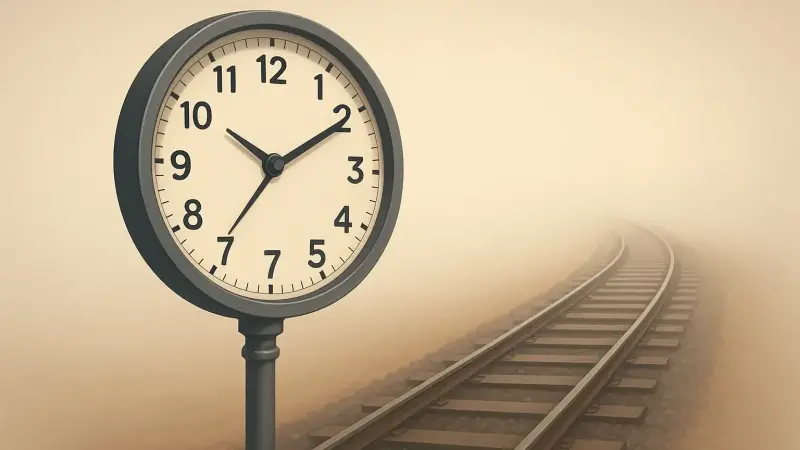
A clock that misbehaves only in fog
On some railway platforms, people swear they’ve watched the station clock jump backward by a few minutes right as the air turns thick and grey. Not a slow drift. A clean, sudden rewind, then it carries on as if nothing happened. It isn’t one single famous station with a documented plaque and a date. It’s more like a kind of story that pops up in different places—often around older rail infrastructure—because fog is when timekeeping and train running get unusually fragile. The “seven minutes” detail varies. The core mechanism, when there is one, is almost never the fog touching the clock. It’s the fog changing how the railway runs the time.
Why railways care about one shared time
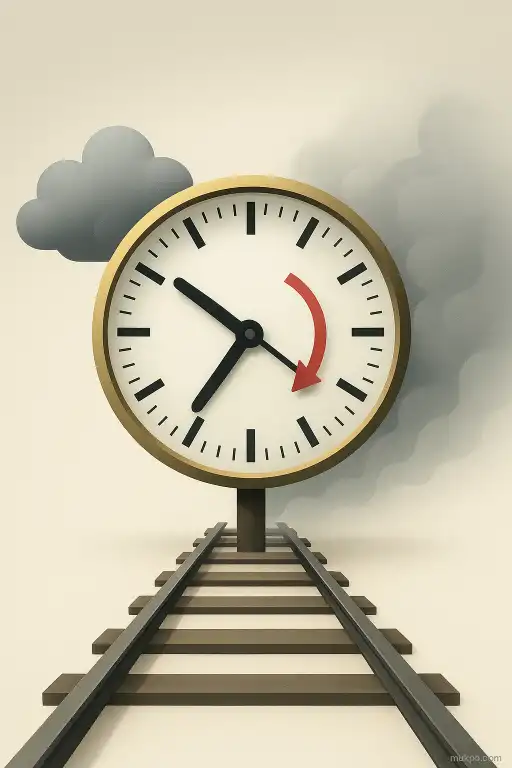
Railways don’t like each clock deciding its own reality. For safety and scheduling, stations typically follow a master time source. Historically that could be a master clock in a control room feeding “slave” dials, or a telegraph pulse sent down a line, or later a radio time signal and then network time. The public clock on the wall might look like a simple analog face, but it often isn’t acting alone.
That matters because a clock that is slaved to a master can jump. If the master system decides the station display is wrong, it can correct it in steps. Some systems only ever correct forward. Others can correct backward if they’re designed to match the master precisely rather than preserve monotonic time. A sudden correction feels like a rewind even if the clock’s internal timekeeping never “ran backward” in a physical sense.
What fog changes operationally
Heavy fog changes the way trains are controlled. Sight lines shrink. Drivers rely more on signals, and operators may slow traffic, increase spacing, or switch to more restrictive procedures. On some networks, degraded visibility can also coincide with degraded communications. Wet air, water on insulators, and condensation in cabinets can all increase electrical leakage and noise, especially on older equipment. None of that has to “break” anything to cause timing systems to behave differently.
One overlooked detail is how often platform clocks are on separate low-voltage circuits with long cable runs. Those runs can pick up interference. If a time-distribution line uses pulses (for example, a pulse per minute), a missed pulse makes the dial fall behind. A later “resync” routine can then snap it back. Fog doesn’t have to be magical. It just has to be the condition when marginal wiring and damp enclosures become marginal enough to miss a beat.
How a clock can “rewind” without reversing its motor
Most public station clocks are built to be legible and cheap to maintain, not to be philosophically perfect about time. Many have a simple stepper movement or an impulse-driven mechanism. If the display is controlled by electronics, the controller can command a correction. That correction might be implemented as a quick series of backward steps, or as a release-and-catch trick where the minute hand is allowed to slip to a new position when a clutch disengages briefly. To a person watching, that looks like the hand jumps back several minutes.
The “seven minutes” figure fits a specific kind of human noticing. People tend to remember a correction only when it is large enough to be undeniable but small enough to seem plausible. A one-minute correction is easy to miss. A half-hour correction gets blamed on a reset. A handful of minutes is the sweet spot where someone feels the oddness, looks around, and then tells the story later with a neat number attached.
A concrete way it could happen on a real platform
Picture an older station with an analog clock fed by a central system. A foggy morning brings damp into a trackside cabinet. The time pulse line gets noisy and the clock misses several minute impulses over a short period. The clock face is now a few minutes slow, but nobody notices yet because trains are also being cautioned and running a bit late. Then a technician’s system, or an automatic controller, compares the local dial against the master and forces a correction. Depending on the hardware, that correction can be applied as a backward jump rather than a gradual catch-up.
Another mundane version is power quality. Foggy weather can coincide with heavier electrical load and more switching on the network. A brief brownout can stall a synchronous motor clock without stopping it completely, leaving it behind by a few minutes. When power stabilizes, some installations don’t slowly regain lost time. They get reset to the master time, and if the reset routine is sloppy, a clock that was accidentally fast can be snapped backward to match. It’s the kind of behavior you only notice on a platform because you’re already watching the clock and waiting.
Related reads
- Replay mode: why you mentally argue with people long after the conversation
- George Washington and the exodus from Philadelphia during the 1793 yellow fever terror
- Neighbors kept finding tiny clay faces nailed into the trunks of maple trees on one street
- A sealed plaster cavity containing a century old shopping list with tomorrow’s date circled
- Phantom phone buzzes: how expectation rewires your touch senses
- How the Royal Mint’s Trial of the Pyx exposed coiners in Georgian London