
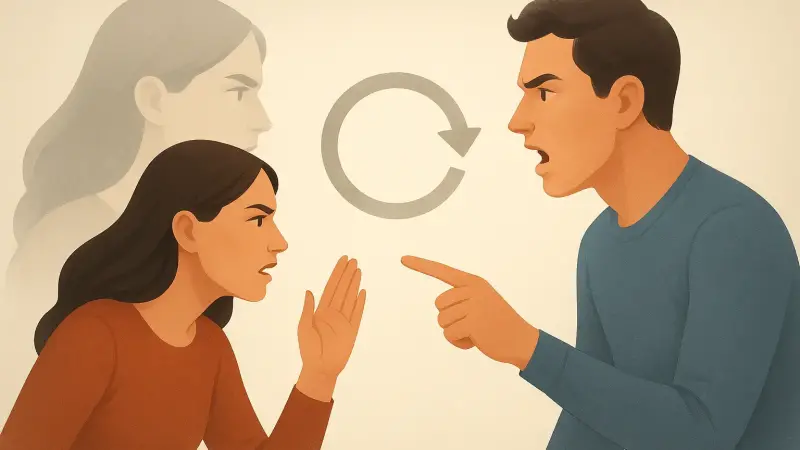
That argument that keeps going after you’ve left
Someone says something offhand in a meeting, or on a call, and you nod and move on. Then, later—on the subway, in the shower, while loading the dishwasher—you replay it. The better version of you shows up late. You deliver the clean sentence. You anticipate their comeback. You win. This isn’t one famous event in one place. It happens after small moments everywhere: a comment from a manager in an office in London, a tense family dinner in Mumbai, a sharp exchange at a café counter in Los Angeles. The core mechanism is that the brain keeps working on unfinished social problems, even when the room is empty.
Why the mind treats talk like a problem to solve
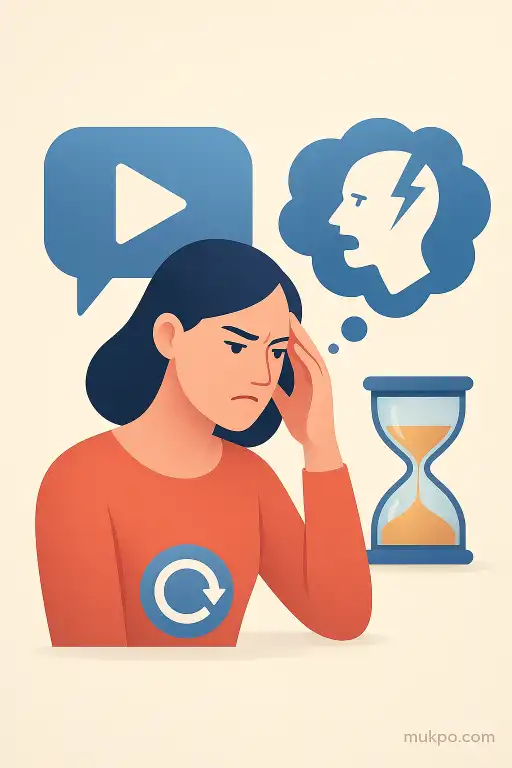
Conversation is fast. Social situations are faster. By the time a sentence lands, the brain is already juggling tone, status, intent, and consequences. That’s hard to close neatly in real time. When the moment ends, the brain can finally run the “slow” processes—organizing what happened, testing different interpretations, and searching for a response that would have protected reputation or belonging.
This is also why the replay often starts when attention drops. Quiet tasks remove incoming demands, so leftover social math comes forward. People usually notice the mental dialogue, but miss the trigger: a tiny sensory cue that matches the original moment. The same notification sound, the same fluorescent lighting, the same chair posture. The brain tags context along with content, and it can pull the whole scene back with one small match.
Why the “better comeback” arrives late
In the moment, the body can be slightly mobilized—heart rate up, breathing shallow, face monitoring, voice control. That state narrows working memory. It also nudges language toward safe, short, socially acceptable lines. Later, when the threat level drops, more resources come back online. Words come easier. You can plan two steps ahead. So the delayed comeback isn’t proof you were weak. It’s often just timing: different brain conditions, different output.
There’s also a social forecasting problem. A real conversation has uncertain responses. In replay mode, the brain can “lock” the other person into predictable lines. That makes it feel solvable. The overlooked detail is that the imagined opponent often uses your vocabulary and your logic, not theirs. The mind is practicing against a simplified stand-in, which is part of why the imaginary exchange can go on for so long without reaching a satisfying end.
Why it sticks to certain people and not others
Not every conversation earns a replay. The sticky ones usually involve status, closeness, or ambiguity. Status because social rank affects access and safety. Closeness because relationships are ongoing, so the brain treats today’s moment as part of a longer pattern. Ambiguity because unclear intent is hard to file away. A blunt comment from a stranger can be annoying, but a vague remark from a supervisor—“Let’s tighten this up”—can loop for days because it lacks a clear target.
Replays also cluster around “face” moments: when someone could have thought you were incompetent, rude, disloyal, or needy. A concrete example: a manager asks for updates on a Zoom call, you hesitate for half a second while the mic icon flickers, and someone talks over you. Later, the brain isn’t only arguing about the content. It’s re-running the timing, the interruption, the pause, the micro-signals that could be read as uncertainty.
Why the internal argument can feel compulsory
Once the brain flags a social moment as unresolved, it tends to keep checking it, like a file that won’t close. That can look like obsessive rumination, but the engine underneath is often basic: error detection plus social learning. The mind keeps trying to extract a rule for next time. What sentence would have reduced risk? What tone would have kept respect? What boundary would have held? It’s rehearsal, but it’s also a search for certainty in a system that rarely offers it.
And because real conversations don’t give clean feedback, the replay can’t easily end. You rarely get a definitive “that response would have fixed it.” You get silence, changed behavior, or nothing at all. So the brain runs another simulation. It tweaks one variable. It tries again. That’s why replay mode can show up hours later with a brand-new line, as if the conversation is still happening somewhere.
Related reads
- George Washington and the exodus from Philadelphia during the 1793 yellow fever terror
- Neighbors kept finding tiny clay faces nailed into the trunks of maple trees on one street
- A sealed plaster cavity containing a century old shopping list with tomorrow’s date circled
- Phantom phone buzzes: how expectation rewires your touch senses
- How the Royal Mint’s Trial of the Pyx exposed coiners in Georgian London
- The piano whose ivory keys rearranged themselves while caretakers slept