
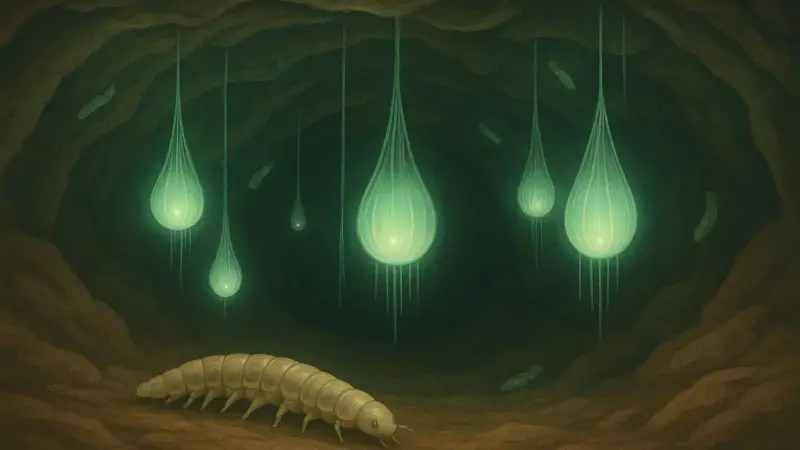
If you walk into a dark cave and see “stars” pinned to the ceiling, it’s hard to believe they’re made by larvae. This isn’t one single cave, either. People see it in Waitomo in New Zealand, in parts of Tasmania, and in caves in southeastern Australia. The lights come from glow worm larvae that hang sticky fishing lines and then switch on bioluminescence to pull prey toward them. The “lantern” isn’t a thing they build once. It’s a living setup: a glowing body placed above a curtain of mucus threads, tuned to the humidity and airflow of the cave.
They start by choosing a ceiling that does the work for them
Glow worm larvae don’t glow well everywhere. They tend to settle on damp ceilings or overhangs where air stays still and moist. That matters because their trap is made of mucus, and mucus dries out fast in moving air. In tourist caves like Waitomo, guides will often point out that the brightest patches cluster where the rock stays wet, not where the ceiling is highest.
One overlooked detail is that cave “weather” can change trap success. After heavy rain, some cave passages get stronger airflow or dripping shifts, and the larvae may be dimmer or clumped differently. It’s not always clear whether a dim patch means fewer larvae or just larvae conserving energy because conditions aren’t ideal for trapping.
The lantern is a baited net, not just a light
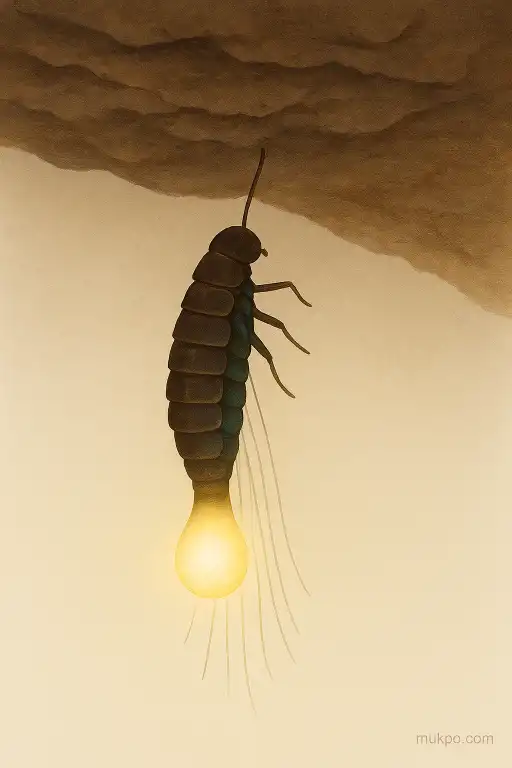
Each larva makes a small silk nest on the ceiling and then drops dozens of sticky threads straight down. The threads are mucus-coated, and they can be different lengths depending on the height of the ceiling and the local airflow. Prey insects that bump into a line get stuck, and the larva reels the line up and eats them.
The glow sits above the threads, which is the whole trick. The light draws flying insects into the space where the lines hang. Without the lines, the glow is wasted. Without the glow, the lines mostly catch whatever happens to drift into them.
The light itself comes from a controlled chemical reaction
The glow is bioluminescence: a reaction where a molecule called luciferin is oxidized by an enzyme called luciferase, producing light with relatively little heat. The larvae can control how bright they are, and the timing. They don’t need to glow at full strength all the time, because making light costs energy they could otherwise put into growth.
It’s also not just a simple on-off switch. Brightness can vary across the night, with hunger, and with disturbance. In caves that get a lot of foot traffic, larvae often dim when vibrations or sudden light changes happen, which can make the ceiling look like it “turns off” in patches.
The cave turns their individual lights into a ceiling full of “stars”
A single larva is a point of light. A cave ceiling can hold thousands. What people perceive as a smooth starfield is really a dense scatter of individuals, each anchored to its own tiny nest. The spacing isn’t random. Larvae compete, and if they are too close, their threads can tangle and they can steal prey from each other.
That competition creates patterns visitors notice without realizing what they’re seeing. Bright “constellations” are often areas where the ceiling geometry lets many larvae hang long, unobstructed threads. Dark gaps can be bare rock, but they can also be zones where threads would constantly brush a wall or drip line and get ruined.
They maintain the lantern by rebuilding parts of it constantly
The trap is fragile. Threads collect dust, get broken by water drops, or lose stickiness. Larvae replace lines, add new ones, and remove old ones. If a section of ceiling suddenly looks less “starry,” it may be because many larvae are spending time repairing and feeding rather than shining brightly.
There’s also a life-stage limit. These “glow worms” are larvae of fungus gnats, not worms. When they eventually pupate and become adults, the feeding-and-fishing setup ends. In a cave, that means the living lantern is always in flux: some larvae are building, some are actively catching, and some are disappearing as they move on to the next stage.
Related reads
- A railway clock that runs backward for seven minutes whenever a heavy fog rolls in
- Replay mode: why you mentally argue with people long after the conversation
- George Washington and the exodus from Philadelphia during the 1793 yellow fever terror
- Neighbors kept finding tiny clay faces nailed into the trunks of maple trees on one street
- A sealed plaster cavity containing a century old shopping list with tomorrow’s date circled
- Phantom phone buzzes: how expectation rewires your touch senses