
What people notice the next morning
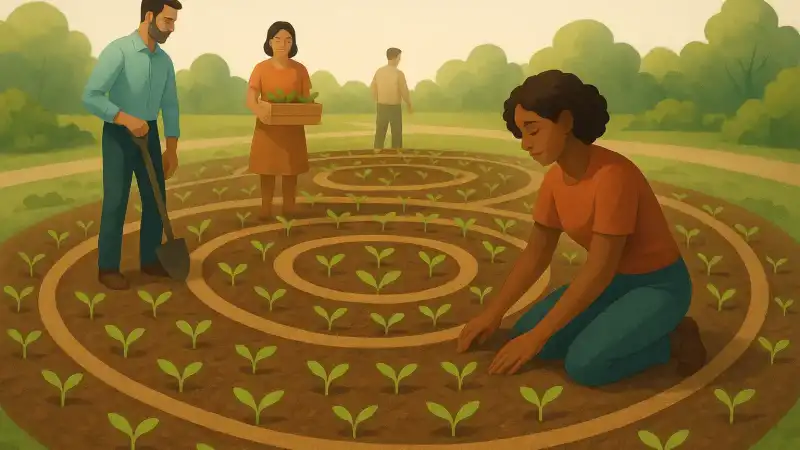
You walk into a shared plot and the new sprouts are not scattered the way they usually are. They sit in clean circles, sometimes several rings nested together, like someone used a compass in the soil. There isn’t one famous “ring garden” everyone agrees on. Reports like this pop up in different community spaces, from allotments in the UK to neighborhood gardens in the US and Australia, and the details vary a lot. The core mechanism, though, tends to be ordinary: something overnight changes where seeds end up, where moisture holds, or where seedlings can survive. The geometry comes from repeated forces, not from plants “choosing” a shape.
Seed placement can become circular without anyone planting a circle
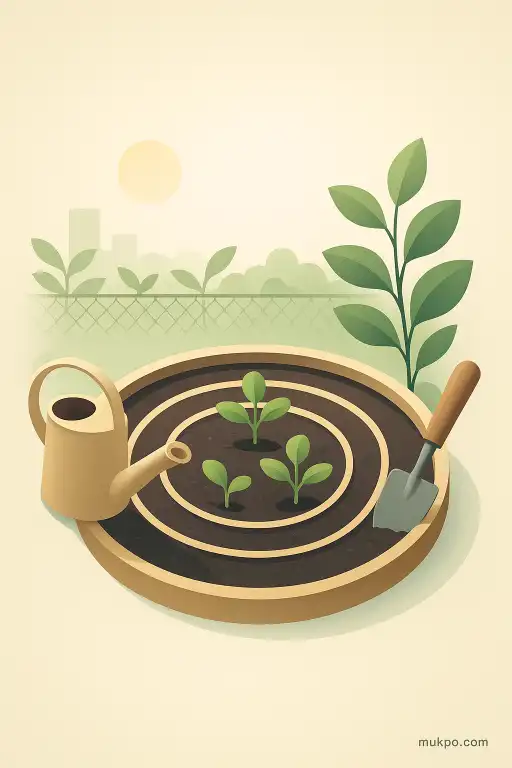
A ring is an easy shape to get when something falls, rolls, or gets pushed outward from a center point. Picture a bucket or watering can set down on bare soil, tipped slightly, then lifted. Seeds stuck to the damp rim can drop in a near-perfect circle. So can fine compost sprinkled through a round sieve or the holes of a circular basket. Even when people swear they didn’t do anything like that, community gardens have a lot of shared tools and casual routines. One person rinses a pot, someone else shakes out a seed tray, and nobody clocks the exact pattern it leaves behind.
Animals can do it too, in a way that looks eerily deliberate. Rodents caching seeds sometimes clear a little center and push loose material outward, leaving a faint ring of disturbed soil. Birds feeding from a central pile can kick and fling husks and seeds into a rough circle around it. The overlooked detail is spacing: if seeds land too close together, many never make it past the first week. A ring can look “designed” simply because seedlings in the middle got thinned by crowding or smothering, leaving a surviving band at the edge.
Water makes shapes when it can’t spread evenly
Water doesn’t soak in like a perfect sponge. It runs along tiny slopes, follows compacted paths, and stops at boundaries where the soil texture changes. If a garden bed was watered at night with a sprinkler that has a fixed radius, you can get arcs and rings of wetter soil. If the water source is a single drip point, moisture can be highest in a donut shape once the top layer dries: the center crusts over, while the edge stays slightly damp and breathable. Seeds germinate where that balance is right, and the result looks like someone drew it.
One specific thing people miss is hydrophobic soil. After a bed dries out hard, parts of the surface can briefly repel water. The first wetting then beads and runs, pooling in a circular front where it finally infiltrates. If seeds are already there, that wetting front can become a germination ring. It’s the kind of effect you only notice if you look at the soil right after watering, not the next morning when the green is already up.
The soil can be “different” in a circle for boring reasons
Community gardens are full of buried circles. Old pots. A sunken bucket that got left behind. A removed tree stump. A compacted spot where a barrel sat all season. Those things change the root zone even after the object is gone. The edge of a buried object often holds a sharp boundary: different compaction, different moisture, different microbes. Seeds sprout along the edge because that’s where oxygen and water are both available. The center can be too dense or too dry, so it stays bare until later, if it fills in at all.
Fertilizer and compost do this as well. A single round spot of rich material can “burn” the center with too much salt or nitrogen, while the perimeter gets the gentler dose plants like. That perimeter then becomes the ring of survivors. It looks like a perfect plan, but it’s really a gradient with a sharp middle.
Some rings are a symptom, not a design
Plant disease can form circles because it spreads outward from a starting point. Certain fungi travel through soil and roots in expanding fronts. The center is where plants were hit first, so it may look sparse or dead while the edge is where new plants are just getting established. In turf, “fairy rings” are the famous version of this, and they can happen in garden beds too. The plants you notice in the ring might not be the cause at all. They might just be the ones able to tolerate the changed soil chemistry at the expanding edge.
The overnight part is usually timing, not speed. A lot of seeds germinate below the surface before you see anything. If temperature and moisture line up, many can break through within the same few hours, so the pattern appears all at once. When the pattern is truly crisp, the best explanation is usually a crisp boundary in the bed: a circle of compaction, a ring of moisture, or a ring where seeds happened to land and only the edge had the right conditions to keep going.
Related reads
- How glow worms build living lanterns in caves
- A railway clock that runs backward for seven minutes whenever a heavy fog rolls in
- Replay mode: why you mentally argue with people long after the conversation
- George Washington and the exodus from Philadelphia during the 1793 yellow fever terror
- Neighbors kept finding tiny clay faces nailed into the trunks of maple trees on one street
- A sealed plaster cavity containing a century old shopping list with tomorrow’s date circled