
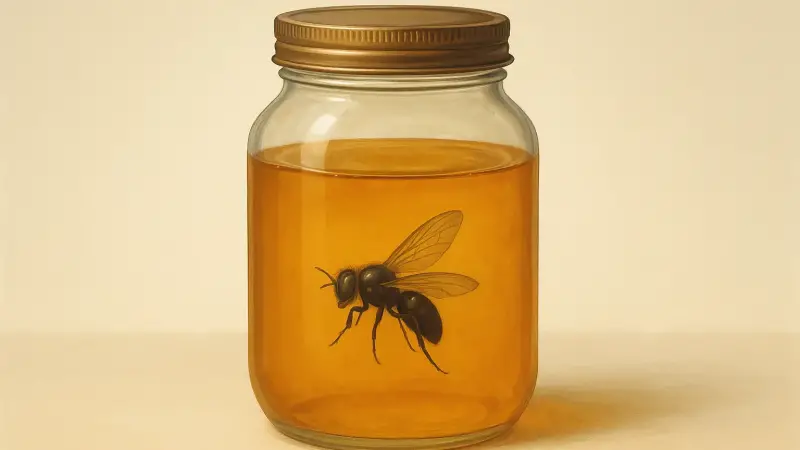
Honey is one of the few foods people expect to stay unchanged for years. So it feels almost reasonable that a buried jar could come up intact, still sticky, still sweet-smelling, and with an insect inside that looks freshly trapped. That part is real. The leap is the label “extinct locally.” There isn’t one single famous place this always happens. Finds like this could be anywhere a sealed jar ends up underground, from a forgotten cellar in rural Europe to an abandoned homestead in North America. The mechanism is simple: thick sugar, low water, and a tight seal can preserve small bodies better than most soil can.
Why honey can preserve a fly at all
Honey is hostile to microbes. Its water activity is low, and its sugars pull moisture out of cells. That makes it hard for bacteria and fungi to grow, especially when the honey is concentrated and the jar stays sealed. A fly that falls in can be “fixed” quickly, not because honey is antiseptic in the way alcohol is, but because decomposition needs water and oxygen and a functioning microbial community.
The overlooked detail is that honey doesn’t preserve everything equally. Soft tissues can collapse or darken. Wings and exoskeleton often keep their shape because they’re already tough and low in water. If the insect ends up fully submerged and the jar doesn’t get diluted by rainwater or condensation, the odds of a crisp-looking specimen go way up.
What “perfectly preserved” usually means
When people say “perfect,” they usually mean “recognizable at a glance.” You can see the body outline, wing veins, bristles, maybe even eye color if the light hits right. That’s different from being chemically unchanged. Pigments can fade. Proteins and DNA can fragment. The insect can also be distorted in ways that only show up under magnification, like a slightly shrunken abdomen or wings stuck at an odd angle.
Context matters, too. A jar that stayed cool and dark tends to preserve better than one that sat through repeated hot summers. Even underground, temperature swings happen near the surface. And honey sometimes ferments if yeast gets going and water content rises, which can create gas and push the lid, letting air in without anyone noticing.
How a species can be “extinct locally” and still show up
Local extinction usually means “not found in surveys for a long time,” not “impossible to exist.” Insects are under-sampled. Many species are seasonal. Some live in narrow microhabitats that people don’t check, like a specific wet ditch margin, a shaded seep, or decaying vegetation in one type of woodland edge. A fly can be present in low numbers for decades and simply not be collected.
There’s also the timeline problem. A jar buried in a cellar wall or dropped into a pit could be from a period when the species still lived there, even if it disappeared later. Without a clear date for when the jar was sealed and buried, the specimen can’t automatically be treated as a “return.” It might be evidence of a past distribution, which is still useful, just a different kind of useful.
What has to happen for the identification to be believable
Fly ID is often about small structures. For many groups, you need to see the pattern of bristles, the shape of certain wing veins, or details at the tip of the abdomen. A casual photo through glass rarely settles it. If the insect is still in the honey, refraction and surface glare can hide key features. If it’s removed, cleaning it without damaging those features is its own challenge.
The other thing people miss is contamination of the story rather than the specimen. A jar can be re-opened and re-sealed at any point in its life. If the lid is modern, or the threading style doesn’t match the supposed age, that raises questions. So does a fly that looks too clean if the honey shows crystallization layers that suggest it sat open for a while before closing.
What scientists can and can’t learn from a fly in honey
A preserved insect can support a historical record: the species existed in that area at some point, and the morphology matches known descriptions. It can also be compared to museum material. In the best cases, imaging can capture details without opening the jar at all, using careful lighting and macro setups. Chemical work is trickier. Honey’s sugars and enzymes can interfere with DNA extraction, and any DNA that remains may be short fragments.
Even when the genetics don’t cooperate, the specimen can still change the conversation around a “missing” local species. Not by proving it’s alive today, but by tightening the last-known window, or by showing that older records weren’t misidentifications. A small sealed jar can hold a surprisingly specific kind of evidence, as long as the chain of assumptions around it stays just as sealed.
Related reads
- A museum label describing a missing painting that should have been in the next room
- A community garden where seedlings sprout in perfect geometric rings overnight
- How glow worms build living lanterns in caves
- A railway clock that runs backward for seven minutes whenever a heavy fog rolls in
- Replay mode: why you mentally argue with people long after the conversation
- George Washington and the exodus from Philadelphia during the 1793 yellow fever terror