
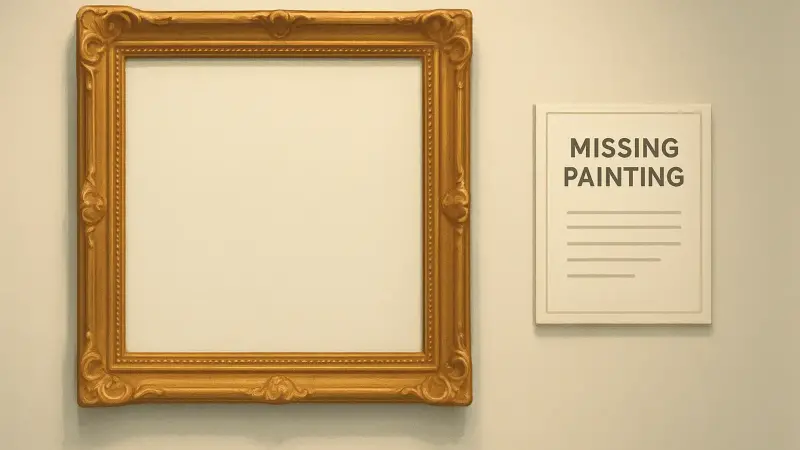
You’re standing in a museum, reading a label that’s oddly specific. Medium, dimensions, lender, maybe even a short quote from a critic. Then you step into the next room and the wall is blank, or it’s filled with something else entirely. This isn’t one single infamous incident. It happens in different ways in different places, from the Louvre in Paris to the National Gallery in London to the Museum of Modern Art in New York. The mechanism is usually simple: labels are printed to match a plan, and the plan changes faster than the label can. Sometimes the change is temporary. Sometimes the artwork never arrives at all.
How a label ends up describing something that isn’t there
Most exhibitions are built from a checklist that locks in months ahead. Curators choose works, registrars negotiate loans, and designers map wall texts to an exact layout. Labels are then produced in batches, often before the final objects are physically on site. If a loan falls through late, or an artwork is pulled for conservation, the label can remain because replacing it isn’t always as easy as swapping paper. Many institutions print on rigid panels, mount them with specific hardware, and try to avoid a cascade of last-minute reprints.
There’s also a timing mismatch that visitors don’t see. The installation schedule can be tight, while the approvals process for text can be slow. Credit lines, ownership wording, and required acknowledgments sometimes need sign-off from lenders or estates. When a work is removed, the museum may not be able to quickly rewrite those parts without restarting approvals. So the label stays, even if it now points to an empty spot or a different object.
The quiet constraints behind the wall
Paintings don’t just hang anywhere. Wall strength, security anchors, and hanging systems are planned for a known weight and frame depth. If the missing painting was supposed to be large, the museum might have already patched and painted a specific area, set the hanging height, and tuned lighting angles for that surface. Replacing it with a different work can create new problems: glare, frame shadow, or a mismatch in spacing that breaks the layout. Sometimes the safest choice is to leave a gap rather than force a substitution that doesn’t fit physically.
Climate and light limits can also knock a piece out at the last moment. Works on paper are especially sensitive, but even some paintings have strict exposure requirements. If a gallery’s light levels can’t be lowered without affecting everything else, that one work may be withdrawn. The label may still be accurate in the catalog sense—yes, it was scheduled—while the object never makes it onto the wall.
What “missing” can mean in museum terms
“Missing” doesn’t always mean lost or stolen. It can mean “not on view,” which is a different status entirely. Museums rotate holdings, close rooms for maintenance, and adjust displays for loans coming in or going out. A label can be left up during a short closure because taking it down and reinstalling it repeatedly risks damaging the wall surface, or because staff expect the object to return within days. Visitors catch the label in the middle of that changeover.
Sometimes the work is present, just not where the label suggests. Galleries get re-sequenced during installation. A painting intended for the “next room” might be moved to a nearby wall to solve sightline issues or to keep a lender’s work away from a doorway. The label can lag behind the new arrangement, especially if the museum is waiting to confirm that the move is final before reprinting.
A concrete example of how it happens on a normal day
Picture a temporary exhibition with a borrowed painting scheduled to arrive on Tuesday. The label is already mounted because the installers need the wall finished before the art handlers start hanging. On Monday night, the lender’s courier flags a problem: the frame has a loose joint, or the surface shows fresh flaking. The lender can refuse installation until a conservator examines it, and that conservator may not be available immediately. The painting stays in its crate, or it’s diverted to a conservation room, and the gallery opens with an empty space and a fully confident label.
The overlooked detail is how specific some labels have to be about credit. They may include “Courtesy of…,” a collection name, or lender language that can’t simply be crossed out. If that lender withdraws, the museum can’t casually reuse the label for a different painting without creating a public paperwork error. So the label becomes a little stranded document, describing an object that is real and accounted for, just not accessible in that spot.
Why museums sometimes leave the mismatch visible
It can look sloppy, but there are reasons it persists. Some museums prioritize keeping galleries open over perfecting interpretive text during an active install period. Others avoid making a fast change that will be wrong again tomorrow. If the painting is expected to appear later in the run, staff may leave the label because it will be correct soon, and removing it would create a new set of holes, touch-up paint, and alignment work.
There’s also a transparency issue, even when it isn’t announced. An empty wall with a label quietly admits that something was planned and didn’t happen. That’s a normal part of working with loans, conservation limits, and shipping. The visitor just happens to see the seams: the exhibition as a schedule, not only as a finished room.
Related reads
- A community garden where seedlings sprout in perfect geometric rings overnight
- How glow worms build living lanterns in caves
- A railway clock that runs backward for seven minutes whenever a heavy fog rolls in
- Replay mode: why you mentally argue with people long after the conversation
- George Washington and the exodus from Philadelphia during the 1793 yellow fever terror
- Neighbors kept finding tiny clay faces nailed into the trunks of maple trees on one street