

Why some fallen leaves glow
If you’ve ever walked a dark trail and noticed a faint greenish glow coming off a patch of leaf litter, you’re not alone. It isn’t one single place or one single fungus. People report it in damp forests in the Pacific Northwest, in parts of Japan, and in the UK’s ancient woodlands. The glow usually shows up after leaves have been on the ground for a while, when a fungus has moved in and started digesting them. As it grows through the leaf veins and the thin layers of rot, it runs a chemical reaction that gives off light. No heat. Just a low, steady shine.
The chemistry is light made on purpose
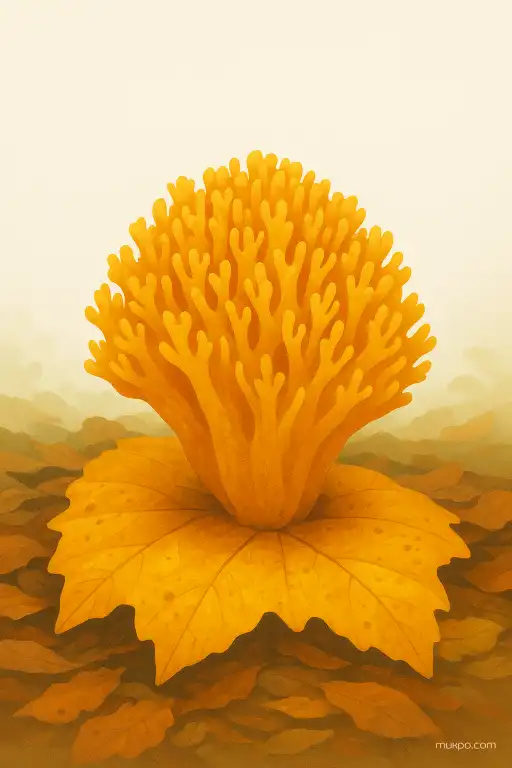
Fungal bioluminescence works a lot like other living light systems: a small molecule (a luciferin) gets oxidized by an enzyme (a luciferase), and the reaction releases energy as visible photons. In fungi, researchers have identified a pathway where a compound derived from lignin-related chemistry is converted into a luciferin, then “spent” to make light, and recycled again. That recycling matters. It’s one reason the glow can be sustained for hours, instead of flashing and stopping.
The light is usually green because that wavelength travels farther through wet plant tissue and is easier to detect in dark understory conditions. Another detail people often overlook is that the brightest parts are not always the mushrooms. It’s often the hidden mycelium inside the leaf mat or wood fibers. A log can look dead and ordinary in daylight, then glow along cracks at night where the fungus is actively feeding.
It starts as a patch and spreads like a stain
What looks like a “luminous carpet” tends to begin as a small colonized area where moisture stays high: a shallow dip in the ground, the shaded side of a log, or a pile of leaves pressed down by rain. Fungal mycelium grows outward in threads, following the easiest routes through the leaf structure. That often means the veins first, because they hold on to water and nutrients longer than the thin leaf blade.
As more of the litter layer gets colonized, the glow can look smooth from a distance, even though it’s really a scattered network of bright filaments separated by darker, uncolonized material. Wind and footsteps can break and remix the leaf layer. That’s why one night the glow seems continuous, and a week later it’s broken into islands or gone entirely.
Not every glowing fungus behaves the same
Several different fungi can produce this effect, and they don’t all choose the same substrate. Some species glow mainly in decaying wood. Others glow readily in leaf litter or at the base of dead branches. Even within a single species, brightness varies with temperature, oxygen, and how actively the fungus is metabolizing. A patch that glows strongly on a mild, wet night may be barely visible after a cold snap.
There’s also a timing wrinkle. The glow often peaks when the fungus is busy breaking down fresh material, not when the litter is already powdery and exhausted. That means the most dramatic “carpet” moments can be brief and easy to miss. By the time a visible mushroom appears—if it appears at all—the leaf mat may have already done its brightest glowing earlier.
What the glow might be doing for the fungus
The function is still debated. One idea is that light helps attract insects and other small animals that can carry spores around, especially in dense forests where wind dispersal is limited. Another idea is simpler: the glow is a side-effect of chemistry the fungus is already running to handle tough plant compounds, and the light just leaks out as a byproduct. Different species could be “glowing for” different reasons, or for none at all.
What’s clear is that the glow isn’t a spotlight. It’s faint and local, and it depends on the fungus staying wet and oxygenated enough to keep the reaction going. That’s why it shows up best in sheltered, humid pockets—places where fallen leaves don’t dry out quickly, and where the fungus can keep quietly eating through the night.
Related reads
- Why volcanoes sometimes explode with blue flames
- A jar of honey unearthed with a perfectly preserved fly from a species thought extinct locally
- A museum label describing a missing painting that should have been in the next room
- A community garden where seedlings sprout in perfect geometric rings overnight
- How glow worms build living lanterns in caves
- A railway clock that runs backward for seven minutes whenever a heavy fog rolls in