
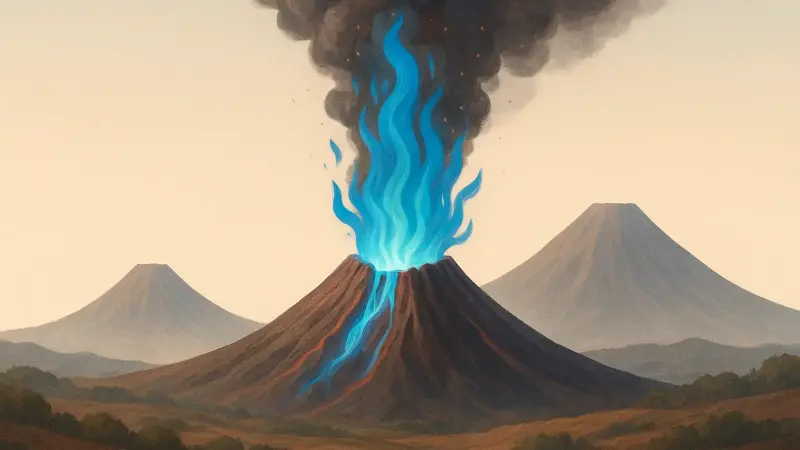
A blue flame isn’t “lava on fire”
Fire is usually orange, so a blue glow on a volcano looks wrong at first. It’s not one single famous event, either. People have seen it at Kawah Ijen in Indonesia, at Kīlauea in Hawaiʻi, and during some eruptions in Iceland. The basic mechanism is simpler than it looks: a volcano vents flammable gases, those gases ignite, and the flame color depends on what’s burning and how hot it is. Blue tends to show up when the flame is hot and relatively clean, with fewer glowing soot particles to make it look yellow-orange.
What’s burning is the gas, not the rock
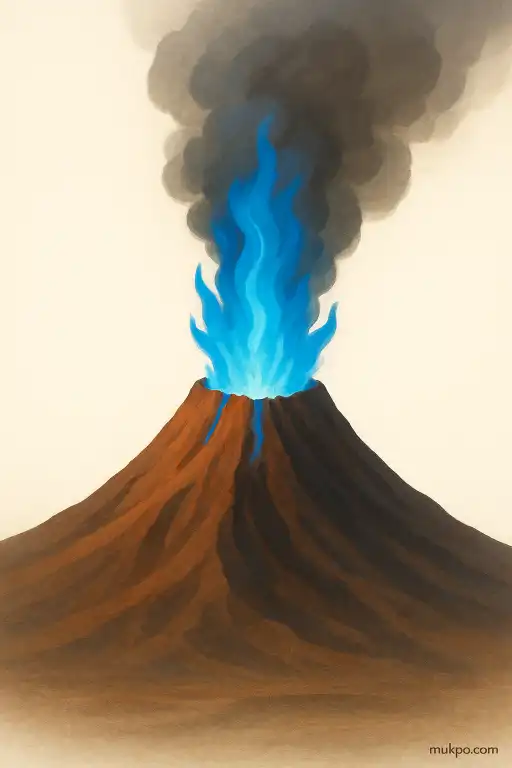
Magma releases gases as pressure drops on the way up. Common ones include water vapor and carbon dioxide, which don’t burn, plus smaller amounts of hydrogen, carbon monoxide, methane, and sulfur compounds. If those combustibles mix with enough oxygen, a spark, hot rock, or even a still-glowing vent can light them. The flame sits in the air above cracks, vents, or a lava channel. That detail matters because people often assume the blue light is the molten rock itself. Most of the time, the rock is just the heat source and the gas supply.
Blue flames also happen when the burn is efficient. With plenty of oxygen and high temperature, the reaction produces little soot. Orange flame is often soot glowing like tiny hot coals. When there’s less soot, you see more of the flame’s true emission, which can skew blue. Wind, vent geometry, and how the gas jets out all affect that mixing. So the same volcano can look normal one night and oddly blue on another.
Sulfur makes the famous “electric blue” nights
The most photographed blue flames are tied to sulfur. Kawah Ijen is a classic example because the crater hosts a sulfur-rich system. The volcano vents sulfur dioxide and other sulfur gases that can be hot enough to ignite at the surface. When they burn, the flames can look blue, and they can also set pools of molten sulfur glowing and flowing. That’s a specific, easy-to-miss point: some of the bright blue scenes include burning gas above the ground plus glowing, liquefied sulfur on the ground, which behaves differently from lava.
Sulfur combustion chemistry is messy. Sulfur dioxide itself isn’t a fuel in the usual sense, but volcanic gas mixtures can include reduced sulfur species like hydrogen sulfide, and sulfur can condense and re-melt near vents. The exact mix varies from place to place and from day to day, which is why reports can sound inconsistent. A small change in temperature or gas composition can flip what you see from a faint blue edge to a dramatic sheet of blue flame.
Blue can also come from hydrogen and carbon monoxide
Not every blue flame needs sulfur. Hydrogen burns with a pale blue flame. Carbon monoxide can burn blue as well. Both can be present in volcanic emissions, especially where hot gases react with rock and with limited oxygen underground. When those gases reach the surface and finally meet enough air, ignition can produce a blue flame that looks “cleaner” than a smoky fire. That’s one reason blue fire has been reported near lava flows at Kīlauea: the heat and the constant gas release create lots of opportunities for localized combustion.
Still, it’s rarely a pure, laboratory-style flame. The colors can shift second to second because the gas jet pulses, the wind shears it, and ash and steam dilute it. Steam is a big spoiler. A vent that is mostly water vapor and carbon dioxide might be just as hot but show almost no flame because there isn’t enough fuel. So the presence of a visible blue burn is partly a matter of the right ingredients arriving together at the surface.
Why it’s easier to see at night, and why it can disappear
Another overlooked detail is how dim blue flame can be in daylight. Human vision is less sensitive to blue in bright conditions, and the sky is already scattering blue light. At night, the same flame suddenly looks intense, especially if your eyes have adapted to darkness. Cameras can exaggerate it too, depending on exposure and white balance, which is why photos from the same scene can look wildly different.
The phenomenon can also stop without the volcano “calming down.” If ash increases, it can smother oxygen near the vent and the flame goes out. If the vent opens wider, the gas may cool and disperse before it can ignite. If the wind shifts, the flame can be blown into a shape that hides it from view. The heat and gas release can continue the whole time, while the blue glow comes and goes like a finicky burner.
Related reads
- A jar of honey unearthed with a perfectly preserved fly from a species thought extinct locally
- A museum label describing a missing painting that should have been in the next room
- A community garden where seedlings sprout in perfect geometric rings overnight
- How glow worms build living lanterns in caves
- A railway clock that runs backward for seven minutes whenever a heavy fog rolls in
- Replay mode: why you mentally argue with people long after the conversation