
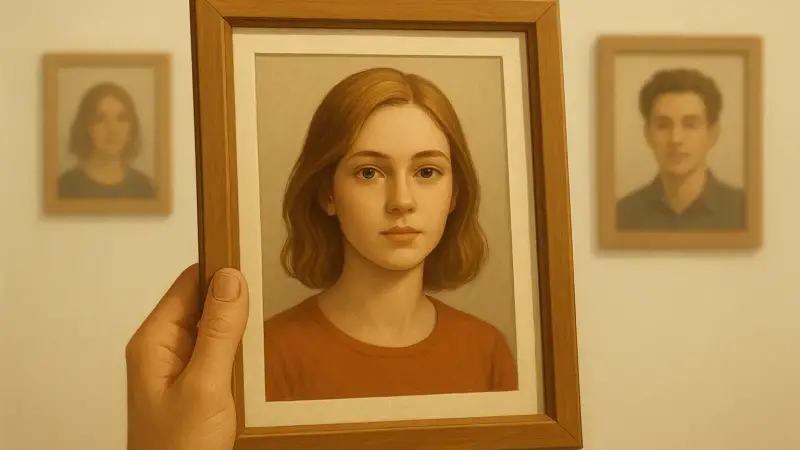
People don’t notice framed photos until they’re wrong. The story here is simple to describe and hard to shake: a photograph turns up already framed, sitting on a shelf or hanging in a hallway, and it looks normal until someone realizes the face in it isn’t the same face they saw last week. This isn’t tied to one verified place or one documented incident. Versions circulate in the U.S., the U.K., and Japan, usually as contemporary folklore rather than a traceable case. The repeating mechanism stays the same. The frame seems familiar, the background stays fixed, and the person in the picture keeps changing.
How it usually enters a home
The photo doesn’t arrive with a dramatic delivery. It shows up through ordinary channels: a thrift-store frame, a box of inherited items, a “free” pile on the curb, a staged rental, a furnished sublet. That’s part of why it works as a story. People can picture the exact moment. You’re carrying a frame because it matches the room, not because you inspected the image. The picture inside is treated like placeholder art, so nobody interrogates it.
There’s often a small practical detail attached: the backing paper is sealed or taped in a way that makes swapping the photo annoying. Sometimes the fasteners are bent flat. Sometimes the dust cover is glued. That doesn’t make replacement impossible, but it raises the bar. It also explains why people don’t “just check” the first day they bring it home.
What changes and what stays fixed
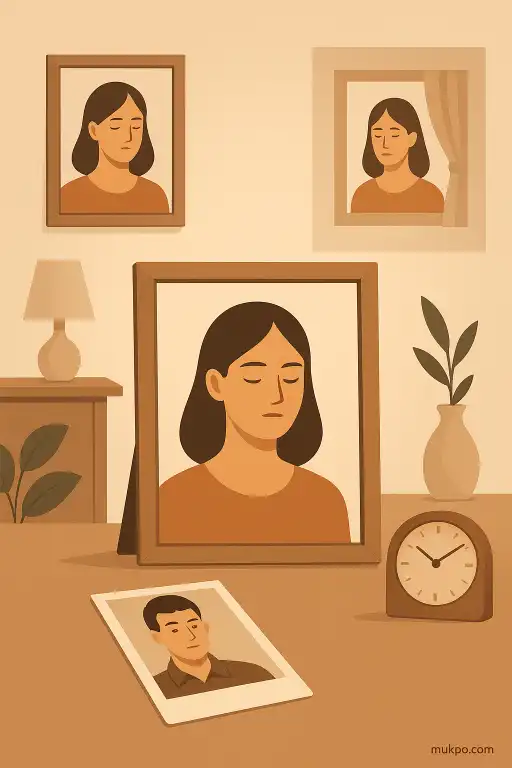
In most tellings, the background stays consistent. The same curtain pattern. The same chair arm. The same window light coming from the same side. Only the face changes, and the new face looks like it belongs there. Not pasted on, not obviously retouched. It’s the kind of change you only catch because you’ve walked past it fifty times. People describe the new person as age-shifted, gender-shifted, or simply “not who it was,” but the pose and composition hold steady.
A detail people tend to overlook is the glass. Reflections make you assume you’re seeing the same image every time. If the frame sits near a lamp or a window, the glare becomes a false constant. That’s why the moment of discovery often happens when the lighting changes—morning sun, a burned-out bulb replaced, a curtain opened. The picture finally shows itself clearly, and the face is wrong.
Why the “new face each week” rhythm shows up
The weekly cadence is oddly common in these stories. It’s not because seven days has special power. It’s because that’s how households track time without trying. Trash day. Laundry day. A regular visit. People notice changes when something else repeats. If you pass the frame on your way out every Monday, Monday becomes the measuring stick. A change that could have happened on any night gets remembered as “it changes every week.”
There’s also a social rhythm. Someone new sees it and asks, “Who is that?” The owner answers automatically, then pauses, because they can’t support the answer. The next time it happens, the story gains structure. It stops being “I might be misremembering” and turns into a pattern with a schedule.
Normal explanations that still feel unsettling
The most ordinary explanation is also the easiest to miss: people are bad at recalling faces they haven’t studied. If the picture is small, slightly washed out, or viewed at an angle in a hallway, the brain fills in the details. A “new face” can be the same face seen with different light, dust on the glass, or a shifted mat that reveals more forehead or chin. Even tiny changes can create the sense that it’s a different person, especially if the original image was never meaningful.
The second explanation is human interference. A landlord, a cleaner, a roommate, a relative tidying up. Somebody swaps the photo for a joke, for staging, or because they assume it’s generic decor. What keeps it creepy is that the swapper may not announce it, and the replacement may be close enough to the old one that it reads as “the same photo, but different.” A black frame with a white mat hides a lot of edge detail, which is where you’d normally catch a different print.
How the story keeps traveling
This kind of account spreads well because it doesn’t require a haunted mansion or a cursed artifact. It requires a frame, a wall, and a routine. It also adapts to new settings easily. In a dorm, it becomes a prank that gets out of hand. In a family home, it becomes an inheritance detail nobody can explain. In a rental, it becomes an anxiety about who has a key. The same core image can be retold without any fixed cast or location.
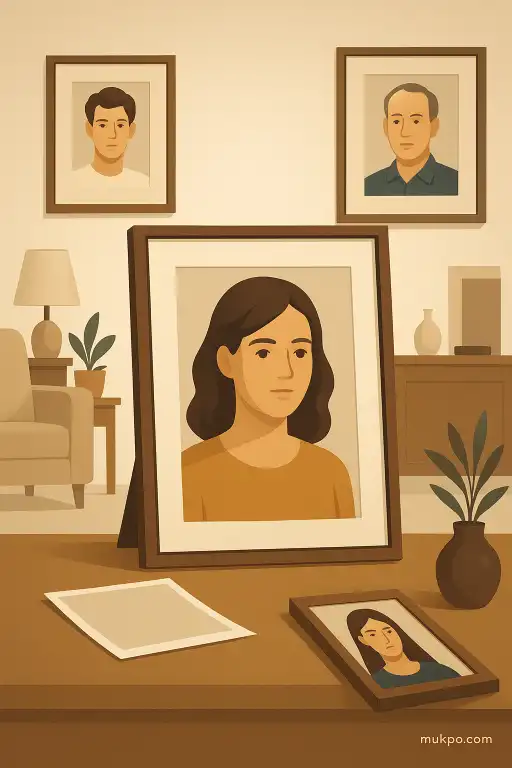
The strongest versions include one situational moment: someone finally takes the frame down to photograph it, and the person in it is someone they recognize from the house itself. Not a celebrity. Not a historical figure. The neighbor’s teenager. The previous tenant from a listing photo. A face that makes the room feel less private than it did five minutes earlier.
Related reads
- Jellyfish that revert to adolescence when stressed
- Sleep fog and the slow brain: what causes those first groggy minutes
- How volcanic ash once cooled climates and shrank harvests
- The fungus that turns tree leaves into luminous carpets
- Why volcanoes sometimes explode with blue flames
- A jar of honey unearthed with a perfectly preserved fly from a species thought extinct locally