
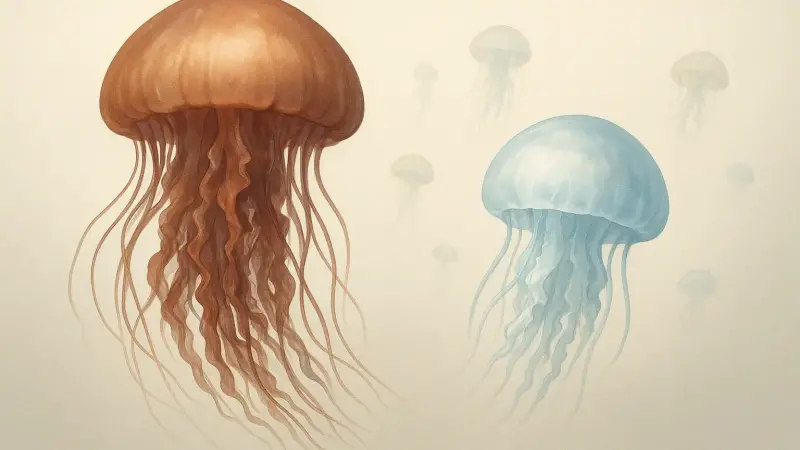
How a jellyfish can go backward
Most animals only get older in one direction. But one small jellyfish breaks that expectation in a very specific way. It isn’t tied to one single place or event. It’s been reported from the Mediterranean Sea, Japan, and other warm coastal waters where it can hitchhike in ship ballast water. The species is Turritopsis dohrnii, often nicknamed the “immortal jellyfish.” When it’s stressed or injured, an adult medusa can sometimes abandon the adult body plan and reorganize itself into an earlier stage. It doesn’t time-travel. It changes form.
The basic mechanism is a cellular reset. Adult cells can switch identities and build the simpler structures of a juvenile stage. That’s the odd part people miss. It’s not “living forever” in the same body. It’s repeatedly returning to a starting point in its life cycle.
The normal life cycle it cheats
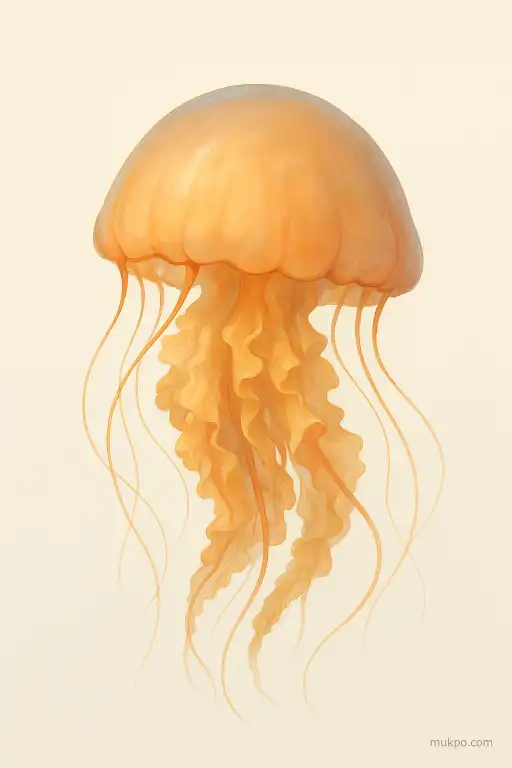
Jellyfish don’t start life as tiny versions of the adult. They usually go egg to larva, then settle as a polyp attached to something hard, then bud off free-swimming medusae. The polyp stage is the quiet one. It can persist for a long time and clone itself by budding. The medusa stage is what people recognize as “a jellyfish,” and it’s typically the end of the line.
Turritopsis dohrnii can sometimes reverse that flow. Instead of dying after reproducing or after damage, a medusa can shrink, lose its tentacles, and turn into a small, blob-like mass. From there it can develop stolons and polyps again, attached to a surface, and later produce new medusae. It’s a loop built into the same life cycle other jellyfish already have.
What “stressed” looks like in real situations
In lab settings, researchers have triggered reversal with things like physical injury, sudden changes in temperature, starvation, and shifts in salinity. Not every individual does it, and the success rate varies across experiments. Sometimes the medusa dies instead. The reversal is an option, not a guarantee.
A concrete scenario is the kind of damage that happens easily in the ocean. A small medusa can be torn by turbulence, nipped by a predator, or battered against a dock piling. A lot of jellyfish are basically one bad tear away from falling apart. In this species, that kind of injury can be the moment when the animal stops acting like an adult and starts rebuilding as a polyp colony.
The cellular trick: changing identity, not just healing
Healing is common in simple animals. What’s unusual here is transdifferentiation. That means a cell switches from one specialized type to another without going back to an unspecialized stem-cell state first. Muscle-like cells, nerve-like cells, and other tissues can be reorganized into the cell types needed for the polyp stage. The animal is, in effect, rewriting which cells do what.
One overlooked detail is that the “reversion” doesn’t produce a miniature medusa. It produces the attached stage. That matters because a polyp can bud repeatedly. So the payoff isn’t a single second chance. It’s the ability to restart a cloning-capable phase. Biologists still debate how often this happens in the wild, because watching a millimeter-scale jellyfish revert on a rock in open water is close to impossible.
Why it doesn’t mean a jellyfish lives forever
The nickname makes it sound like the animal is exempt from death. It isn’t. Individuals can be eaten, infected, or simply fail the reset. Even if the reset works, you can argue it’s not the same “individual” in the way people mean it, because the body plan is dismantled and rebuilt, and the polyp may go on to bud multiple medusae. What persists is genetic continuity more than a continuous adult body.
It also isn’t the only creature that can move backward developmentally. Some sea anemones and other cnidarians can regenerate dramatically, and many animals can pause development under stress. But Turritopsis dohrnii is a clean, almost literal example of an adult form reverting to an earlier life stage, using cell identity changes rather than just regrowing missing parts.
Related reads
- Sleep fog and the slow brain: what causes those first groggy minutes
- How volcanic ash once cooled climates and shrank harvests
- The fungus that turns tree leaves into luminous carpets
- Why volcanoes sometimes explode with blue flames
- A jar of honey unearthed with a perfectly preserved fly from a species thought extinct locally
- A museum label describing a missing painting that should have been in the next room